Bittensor subnets live and die by the integrity of their evaluation process. If miners can figure out exactly which data sample a task was generated from, they can learn to game the scoring instead of genuinely solving the task, and the whole incentive mechanism stops measuring what it is supposed to measure. That is the exact problem ChronoSeek, a Video Moment Retrieval subnet, set out to solve. Their evaluation dataset is public, but which specific samples get randomly selected to generate each task has to stay hidden from miners. The team found that layer in Hippius, built for exactly this kind of verifiable, distributed storage. Here is how ChronoSeek uses Hippius distributed storage to protect its task generation process and harden its validator pipeline against gaming.
The Challenge for ChronoSeek
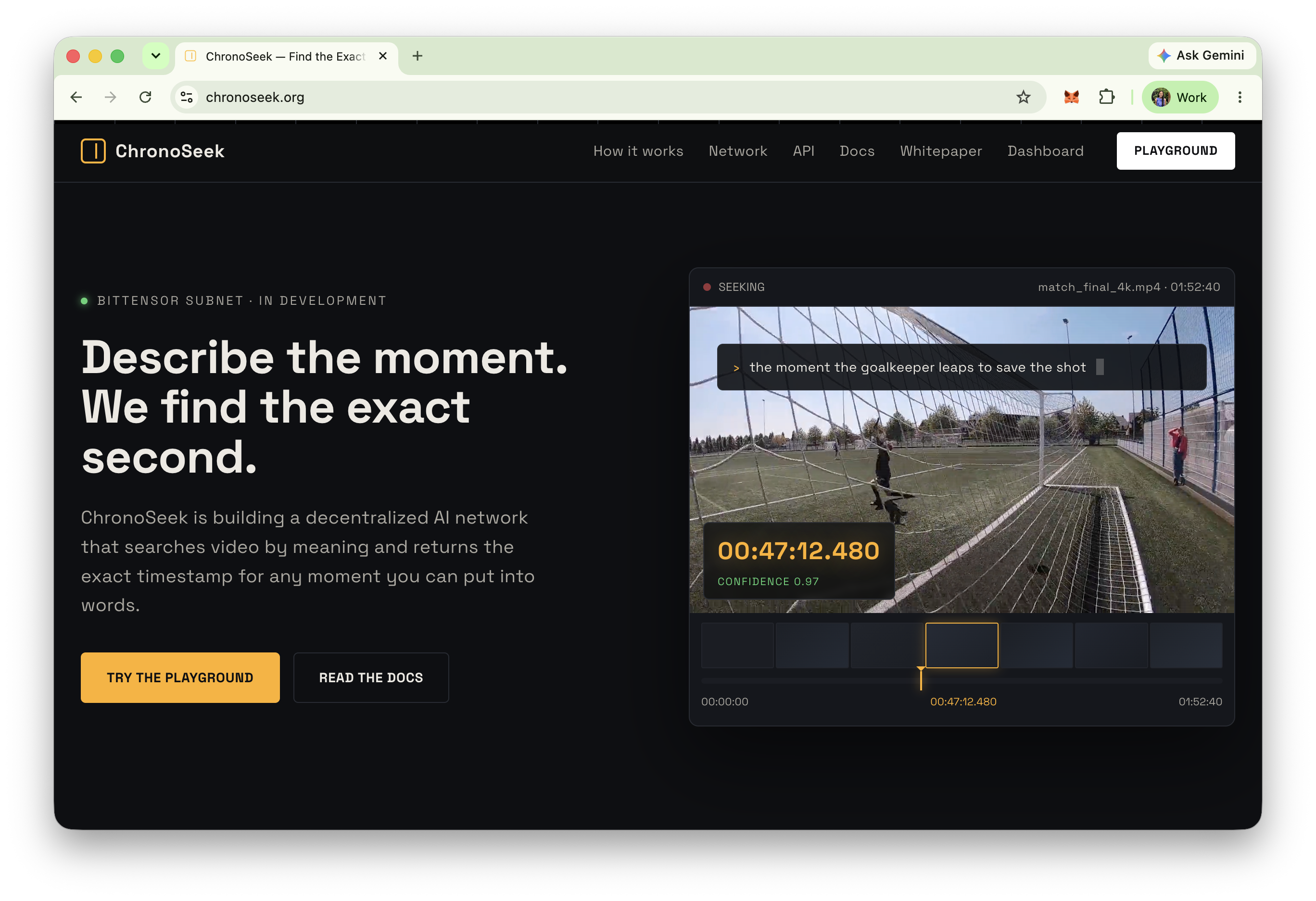
ChronoSeek's validators generate synthetic evaluation tasks by randomly selecting moments from a public benchmark dataset, clipping them, and applying transformations before sending the result to miners. As Bittensor Subnet 20 (SN20), ChronoSeek's entire incentive mechanism depends on miners competing fairly to retrieve the correct moment, which only works if the evaluation itself cannot be gamed. The dataset itself was never the problem, since it is public. The problem was keeping the specific samples selected for each task hidden from miners.
If miners could identify which specific sample a task was generated from, they could look up the original context or exploit patterns in the source material instead of genuinely solving the task. This is a well documented risk in AI evaluation more broadly. Research into test set contamination in language models has found that even partial exposure to which samples make up a benchmark can inflate reported performance and undermine the reliability of results, exactly the failure mode ChronoSeek needed to design around from the start.
ChronoSeek needed a way to publish the transformed task artifact publicly, so miners could retrieve it through a simple interface, while keeping the identity of the source sample completely out of reach. Before integrating Hippius, the team did not have a storage layer built for that specific job. Off the shelf storage could hold files, but it could not decouple a public task artifact from the private sample selection process without adding complexity to the miner facing protocol.
The Role of Hippius in ChronoSeek's Validator Pipeline
Hippius now sits at the center of ChronoSeek's anti-gaming pipeline. Instead of sending miners a direct reference to the original sample or source video, validators upload the processed, transformed clip to Hippius and distribute only the Hippius URL.
That single change breaks the link between what miners see and which sample it came from. Miners still get a simple, consistent interface: fetch the task artifact from its Hippius URL and get to work. What they no longer get is any path back to the source sample.
"Our dataset is public, but which sample gets selected to generate each task can't be. Hippius let us decouple the task artifact from that selection entirely, giving us exactly the kind of storage-level privacy any team handling sensitive data needs."
— Connor Daly, Founder & CTO at ChronoSeek
This matters for any AI infrastructure team building on Bittensor. Subnets like ChronoSeek run on competition: miners are rewarded for the accuracy of their work, and validators exist to score that work fairly. That fairness depends entirely on which samples get selected staying hidden, even as the tasks derived from them are made public.
Keeping the Source Dataset Itself Available
Protecting which sample gets selected is only half of ChronoSeek's storage story. The other half is making sure the underlying dataset survives at all.
ChronoSeek's synthetic task generation starts from a public benchmark dataset hosted on Hugging Face, which points to source videos hosted on YouTube. That is a common setup for video datasets, since hosting the metadata on Hugging Face and linking out to the video itself avoids duplicating large files. It also means the dataset is only as reliable as those external links. Videos get taken down, accounts get deleted, and a link that worked when the dataset was published can quietly stop working later.
Where a source video is no longer available on YouTube, ChronoSeek downloads what it can, uploads it to Hippius's S3 compatible storage, and republishes the complete dataset, including those recovered videos, through Hippius Hub. That gives ChronoSeek a version of its own benchmark that does not depend on YouTube staying up or on HuggingFace's own hosting choices, with everything in one place instead of split across two external platforms.
Why ChronoSeek Chose Hippius
A few things made Hippius a fit for this specific workflow, beyond generic object storage for AI teams looking for somewhere to park files.
- Clean separation between public and private data. Hippius's S3 compatible storage let ChronoSeek hide which sample was selected while keeping the task artifact easy for miners to reach, without redesigning their existing tooling.
- No change to the miner facing protocol. Hippius URLs behave like any other object storage link, so miners never needed new tooling. The switch happened entirely on the validator side.
- Built-in resilience. If another processing step goes down, validators fall back to a local pipeline and still upload to Hippius. Storage is never a single point of failure.
- One platform, two jobs. Hippius handles both task artifact distribution and recovering source videos that disappear from YouTube, so ChronoSeek isn't stitching together separate tools for each problem.
- A natural fit for a distributed subnet. ChronoSeek's own architecture is distributed by design, so a distributed storage layer kept the whole pipeline consistent end to end.
The Result
The impact for ChronoSeek has been architectural rather than a change in raw numbers, and that is precisely the point. Since integrating Hippius:
- The specific sample used to generate each task is never exposed to miners
- Synthetic task artifacts are distributed independently through Hippius
- The pipeline has an added layer of protection against sample fingerprinting and metadata leakage
- Storage has a fallback path, so it never becomes a single point of failure
"Since integrating Hippius, our task generation pipeline has become cleaner, more secure, and genuinely resilient. If any other step in our stack goes down, we can still fall back to a local process and know Hippius has the storage covered, so it's never a single point of failure."
— Connor Daly, Founder & CTO at ChronoSeek
ChronoSeek's approach is a pattern any team evaluating AI models can borrow: keep sample selection hidden, distribute only the public task artifact, and never let storage become a weak link.
Ready to build on a distributed storage layer you can actually verify?
See what Hippius can do for your infrastructure
About ChronoSeek
ChronoSeek is a Video Moment Retrieval subnet built on Bittensor, running as Subnet 20 (SN20). Its validators generate synthetic evaluation tasks from a public benchmark dataset and score miners on how accurately they can retrieve the correct moment, all while keeping which samples were selected hidden from miners.
Website | Docs | Whitepaper | GitHub
About Hippius
Hippius is a distributed cloud platform built to give users a verifiable alternative to providers like AWS and Google Cloud. Files are encrypted and distributed across an independent network rather than held in a single provider's data center. Every storage claim, payment, and miner action is recorded on Hippius's own blockchain, so instead of asking users to trust the platform, Hippius lets them check it for themselves. On top of that foundation sits a full product suite: personal cloud storage, S3-compatible object storage with no egress fees, confidential computing on secure hardware, and a container and model registry for AI. Hippius was built by The Nerve Lab.
Website | Discord | Twitter | Docs | Blog | Medium | Forum | Github
\