Nvidia has reportedly agreed to buy Hugging Face for $12.9 billion, according to reporting from The Information, later picked up by CNBC. For the millions of developers who load models through transformers, diffusers, or the wider huggingface_hub ecosystem, the immediate question isn't really about the price. It's about who ends up owning the infrastructure that decides how open source AI gets distributed, and whether that changes what "open" means in practice. That's pushed a real wave of interest in Hugging Face alternatives, and hardware neutrality is now a legitimate part of that evaluation, not just a hypothetical one. Hippius is answering that search with a model and container registry run by a company with no stake in what hardware you deploy on.
What the Nvidia-Hugging Face Deal Changes for Model Hosting
Hugging Face built its position on being the neutral ground of AI infrastructure. It doesn't build a dominant proprietary model of its own; it's the place where Meta's Llama weights, Alibaba's Qwen releases, and thousands of independent fine-tunes get published and downloaded, regardless of what hardware anyone plans to run them on. That neutrality is precisely what a Nvidia acquisition puts in question.
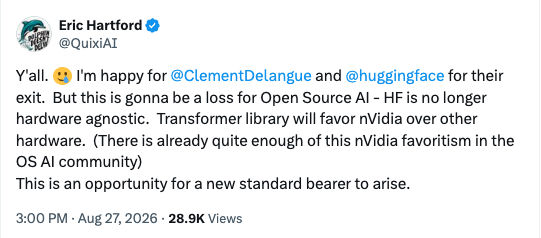
Coverage of the deal has been explicit about this tension. As one analysis put it, Hugging Face's reputation rests on being vendor-agnostic, with no single GPU maker controlling the model hub that millions of developers rely on daily (Gadget Review). Its Optimum libraries today carry first-class support for AMD, Intel, and AWS silicon. Whether that investment continues under a GPU maker's ownership is a matter of intent and enforcement going forward, not something guaranteed by the deal itself. A conversation clip cited by developers this week put the concern bluntly: a Transformers library that historically served all hardware equally now sits inside the company that makes the hardware it's most often compared against.
None of this means the deal is bad for AI progress broadly. It's a real signal, though, that teams who care about hardware-agnostic infrastructure should know what their options are before they need them.
Why Hardware-Neutral Infrastructure Matters for AI Teams
Model hosting isn't just a storage decision. It shapes what hardware a team can realistically deploy on later, and how exposed a project is if a platform's incentives shift. A few concrete reasons hardware neutrality matters in practice:
- Portability. A registry that's agnostic about where a model runs keeps a team free to choose GPUs, TEEs, or CPUs based on price and availability, not based on what one vendor prefers to optimize for.
- Resilience. Teams building on self hosted ai infrastructure aren't exposed to a single company's roadmap or acquisition decisions the way teams relying entirely on one hosted platform are.
- Competitive pricing. The broader field of ai infrastructure companies is only genuinely competitive if models and containers can move between providers without a rebuild. Lock-in at the registry layer undercuts that.
This is also why object storage for ai has become its own category of decision, separate from which model hub a team publishes through. The registry and the storage layer underneath it both carry the same neutrality question.
Hippius Hub: A Hardware-Agnostic Model Registry
Not every Hugging Face alternative solves the same problem. The registry worth switching to should clear a short list: compatibility with existing huggingface_hub code, standard container support for Docker and OCI artifacts, and an operator with no hardware business, no reason to care whether your model runs on Nvidia, AMD, a TEE, or a CPU.
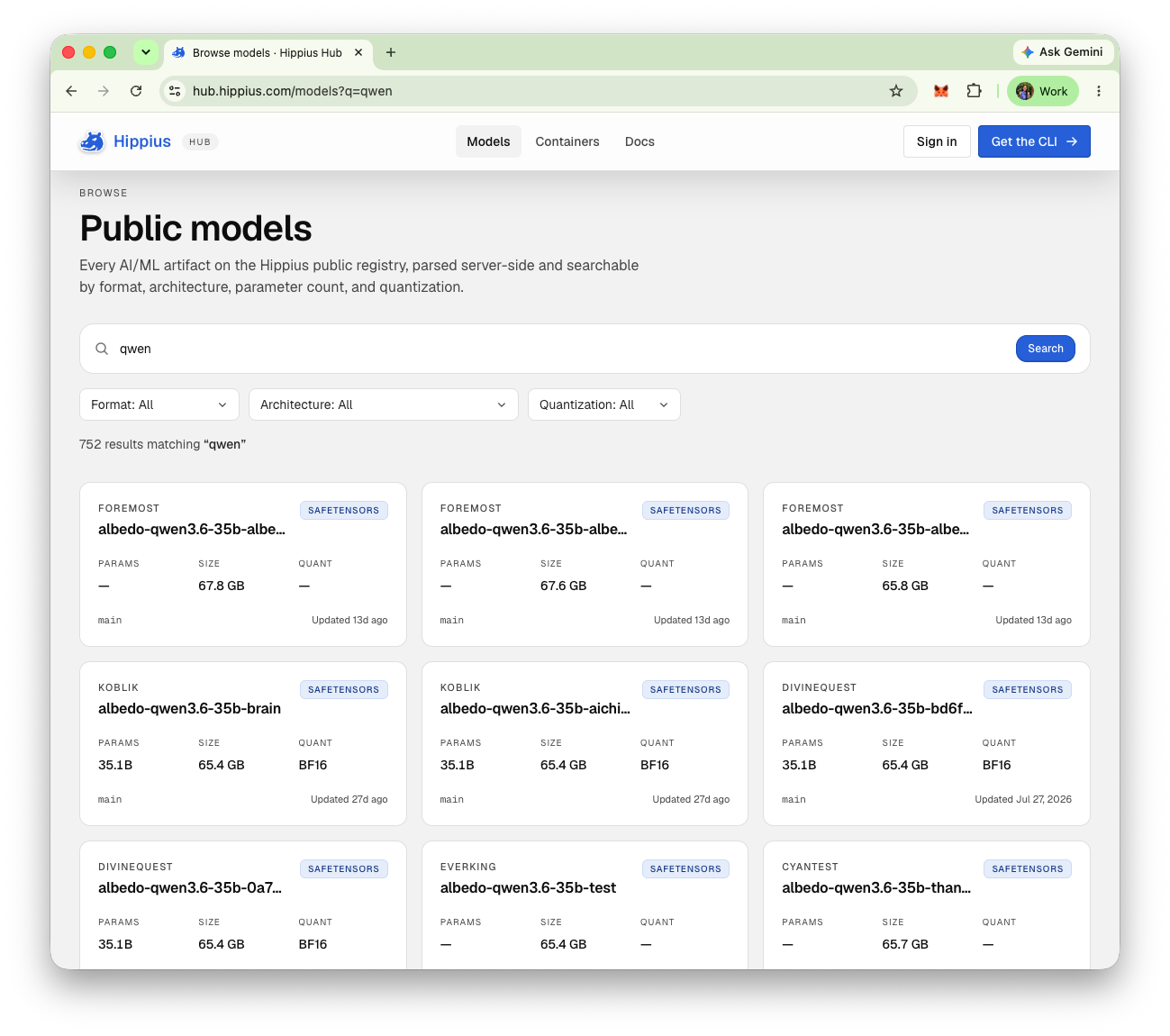
Hippius Hub is built to clear that bar. It's a public registry for AI models and container images, run by a company that sells neither inference nor silicon. Hippius stores and serves models, and has no stake in what you run them on. It has two faces that share the same authentication and backing storage: a model registry and a standard OCI container registry. Its free tier is usable on its own, and paid tiers are available for teams that need more; current plans are listed on the pricing page.
Compatible with huggingface_hub
The model registry mirrors the Hugging Face Python API. Existing code using huggingface_hub keeps working with a one-line import swap:
from hippius_hub import snapshot_download # was: from huggingface_hub import snapshot_download
local_path = snapshot_download("my-models/qwen-7b")
And loading into transformers is one step through the local path:
from transformers import AutoModel
model = AutoModel.from_pretrained(local_path)
Same function signatures, same exception classes, same cache schema. hf_hub_download, snapshot_download, upload_folder, and the HfApi surface all work the way your existing code expects.
Also a Standard OCI/Docker Registry
The container side works exactly the way docker push and docker pull already work. docker, podman, and oras clients are all supported. A public image needs no login at all: docker pull registry.hippius.com/my-models/my-app:v1.
And because it's a standard OCI registry rather than a proprietary API, nothing about it locks you in. A team that pushes to Hippius Hub can mirror or migrate with standard tooling at any time. That portability is the point: a registry only counts as neutral ground if leaving it is as easy as joining it.
Common Questions about Hugging Face Alternatives
Is there a free Hugging Face alternative?
Yes. Hippius Hub is free to browse, and public models and container images can be pulled without an account, no login, no API key. The free tier is usable on its own for hosting public models; see the pricing page for current quotas and what the paid tiers add.
Do Hugging Face alternatives support Docker and container images, not just models?
Some do. Hippius Hub, for example, functions as both a model registry and a standard OCI container registry from the same namespace, so a team doesn't need separate infrastructure for models and containers.
Final Thoughts
The Nvidia-Hugging Face deal doesn't change what any existing model or container needs to run. It does change who controls the infrastructure a huge share of the AI ecosystem depends on, and that's a reasonable moment for teams to check whether their model hosting is tied to one company's hardware preferences. Hugging Face alternatives run by operators with no hardware stake, like Hippius Hub, are worth a look regardless of how the deal itself plays out. Browse the registry or push your first model at hub.hippius.com.
About Hippius
Hippius is a distributed cloud platform built to give users a verifiable alternative to providers like AWS and Google Cloud. Files are encrypted and distributed across an independent network rather than held in a single provider's data center. Every storage claim, payment, and miner action is recorded on Hippius's own blockchain, so instead of asking users to trust the platform, Hippius lets them check it for themselves. On top of that foundation sits a full product suite: personal cloud storage, S3-compatible object storage with no egress fees, confidential computing on secure hardware, and a container and model registry for AI. Hippius runs as Subnet 75 on Bittensor and was built by The Nerve Lab.
Website | Discord | Twitter | Docs | Blog | Medium | Forum | Github