Vidaio helps creators, streamers, and platforms upscale and compress video without running that processing infrastructure themselves. Users upload a video, a distributed network of processing nodes handles the enhancement work, and the finished file comes back ready to download, which means storage sits at the center of everything Vidaio does.
To run that pipeline, Vidaio moved its storage layer from Amazon S3 to Hippius, lowering their storage costs without changing anything about how the pipeline itself works. The Vidaio team estimates the cost savings at around 50%. For a team evaluating an amazon s3 alternative, that's the practical result: the same data movement, for roughly half the cost, with nothing to rebuild.
Every Video Job Means Moving Data Twice
Vidaio's product depends on moving large video files around constantly. A user uploads a video for processing, that file gets handed off to a distributed network of miners, and the finished result comes back and needs somewhere to live until the user downloads it. At video file sizes, both the storage bill and the cost of repeatedly reading that data add up fast, and most object storage providers charge for every byte moved out the door, which makes that worse the more usage grows.
Before Hippius, Vidaio ran this entire pipeline on Amazon S3. It worked, but as usage grew, the cost of running a pipeline that constantly moves large video files in and out became harder to justify, especially with a bill that charges for every byte leaving the network on top of what's stored.
A Cheaper Drop-In Replacement for AWS S3
The deciding factor was simple: Hippius does the same job for less, without asking Vidaio to rebuild anything.
"We moved our video processing pipeline from AWS S3 to Hippius for one simple reason: to save costs. The switch was seamless, nothing about our workflow changed, we just pay less to move the same data."
— CTO & ML Engineer at Vidaio
Because Hippius offers S3 compatible storage, Vidaio could point its existing integration at Hippius without rewriting the upload, processing, or download logic that already worked. Hippius's storage works the same way AWS S3 does from a developer's point of view, so the tools and code Vidaio already had kept working without changes. Switching over was a matter of pointing their existing setup at a new address, not rebuilding it.
The pricing model is where the actual savings show up. Hippius bills for storage on a usage basis rather than a flat monthly plan, with no long-term contract to commit to and no penalty for scaling up or down as Vidaio's processing volume changes week to week. That matters more for a video pipeline than it would for a workload that just sits on data, because Vidaio's files move in and out constantly. Cloud egress fees are the part of a typical AWS bill that punishes exactly that kind of usage, charging every time data leaves the network. Hippius charges nothing to move data out, so the cost of running the pipeline doesn't climb just because usage does. Hippius pricing can be viewed at hippius.com/pricing.
How Video Moves Through Vidaio's Pipeline on Hippius
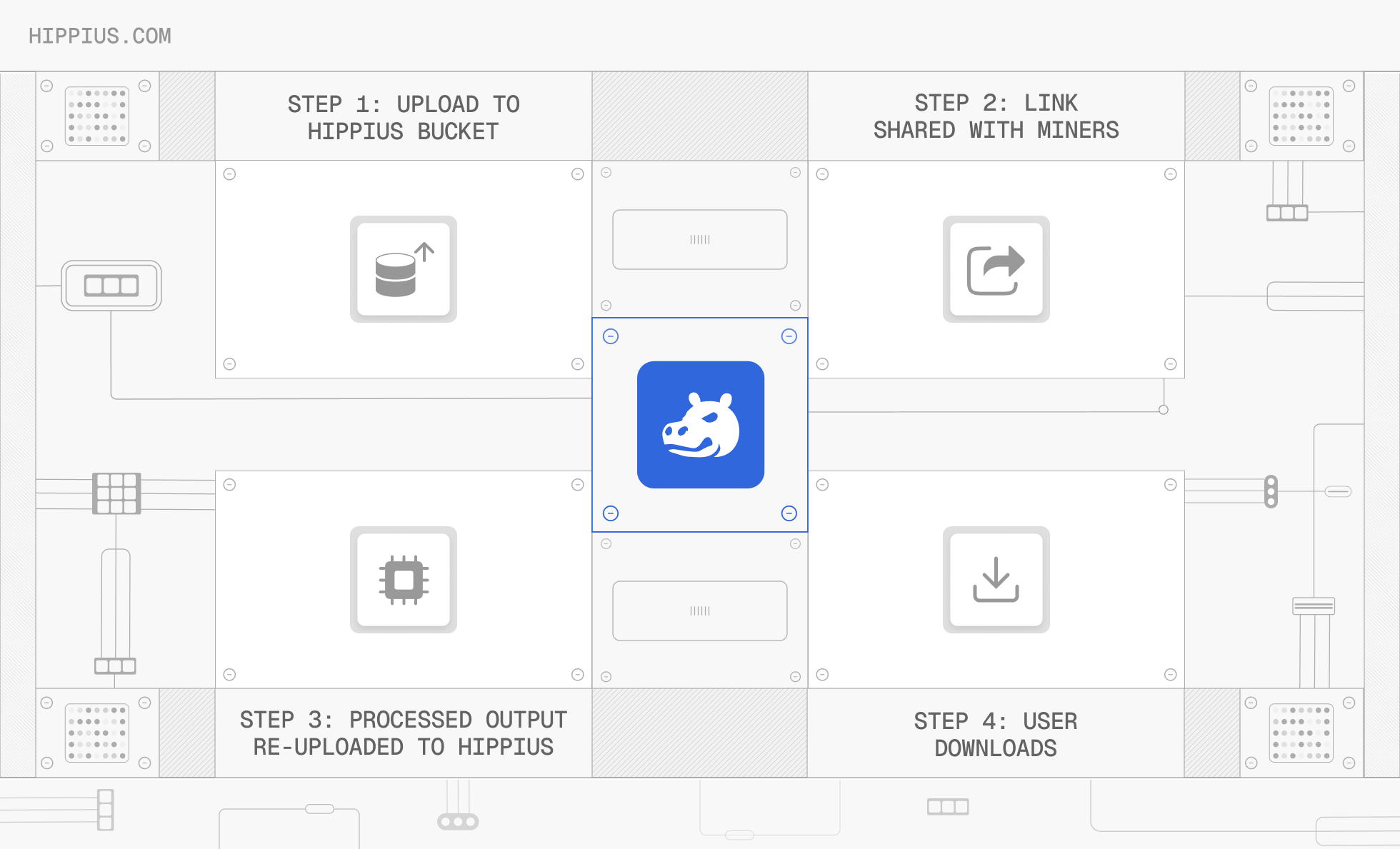
Hippius sits at both ends of Vidaio's processing pipeline. When a user uploads a video for processing, it lands first in a Hippius bucket. Vidaio shares that link with the network of miners handling the processing job. Once the miners return their processed segments, Vidaio combines them and uploads the finished file back to Hippius, where the user downloads it.
Underneath that flow, storage runs on Arion, Hippius's own storage engine. Files are spread across an independent network of storage nodes instead of sitting on one server, and the network repairs itself automatically if a node drops out. That means a job's files stay available through repeated reads and writes, without depending on any single machine staying online. Every storage claim and file operation is also recorded on Hippius's own blockchain, which anyone, including Vidaio, can check directly at hipstats.com rather than taking it on the provider's word.
"Videos come in, we hand miners the link, and the finished file goes right back into the same bucket for the user to grab. It runs exactly like our old AWS setup did, we just pay less for it."
— Ahmad Ayad, CTO & ML Engineer at Vidaio
On the security side, the storage backing Vidaio's pipeline is encrypted at rest, the same standard model used across mainstream cloud storage. That two-way flow, in and out repeatedly for every job, is exactly the kind of usage pattern where s3 data security and predictable costs matter more than they do for storage that just sits untouched.
What Changed After the Switch
- Lower storage cost. The primary reason for the move. Vidaio puts the savings at roughly 50% compared to their previous AWS S3 spend.
- No workflow disruption. The S3-compatible API meant Vidaio's existing integration worked against Hippius without changes.
- No egress fees. Vidaio's pipeline reads and writes the same file multiple times per job; not paying to move that data out changes the economics of a video-heavy workload.
- Redundancy on Vidaio's own terms. Vidaio kept AWS and Backblaze as backup providers for their storage, giving them a fallback if needed for any reason. Hippius's low pricing is what makes keeping that redundancy affordable.
The Result: Lower Costs, Same Workflow
Vidaio runs its video pipeline on Hippius today, at roughly half the cost of its previous AWS S3 setup by their own estimate, with the same workflow it had before. For a video processing platform where storage is touched on every single job, that combination, an amazon s3 alternative that cut costs without a migration project, was the whole point.
If your own pipeline moves data as often as Vidaio's does, it's worth checking what the same switch would look like for you. See current Hippius pricing and get started with S3-compatible object storage.
About Vidaio
Vidaio is a distributed video processing platform that handles AI-powered video upscaling and compression at scale. Users upload video and a distributed network of processing nodes handles the enhancement work, giving creators, streamers, and platforms a way to process large volumes of video without maintaining that infrastructure themselves. Output is scored against quality metrics before it's returned, so the network rewards accuracy rather than just throughput. Vidaio's stated mission is to make high-quality video enhancement more affordable and accessible, an alternative to the manual, centralized workflows most video platforms are still built on. The project is open source, with its core upscaling and compression models available on GitHub.
Website | GitHub | X | Discord
About Hippius
Hippius is a distributed cloud platform built to give users a verifiable alternative to providers like AWS and Google Cloud. Files are encrypted and distributed across an independent network rather than held in a single provider's data center. Every storage claim, payment, and miner action is recorded on Hippius's own blockchain, so instead of asking users to trust the platform, Hippius lets them check it for themselves. On top of that foundation sits a full product suite: personal cloud storage, S3-compatible object storage with no egress fees, confidential computing on secure hardware, and a container and model registry for AI. Hippius runs as Subnet 75 on Bittensor and was built by The Nerve Lab.
Website | Discord | Twitter | Docs | Blog | Medium | Forum | Github