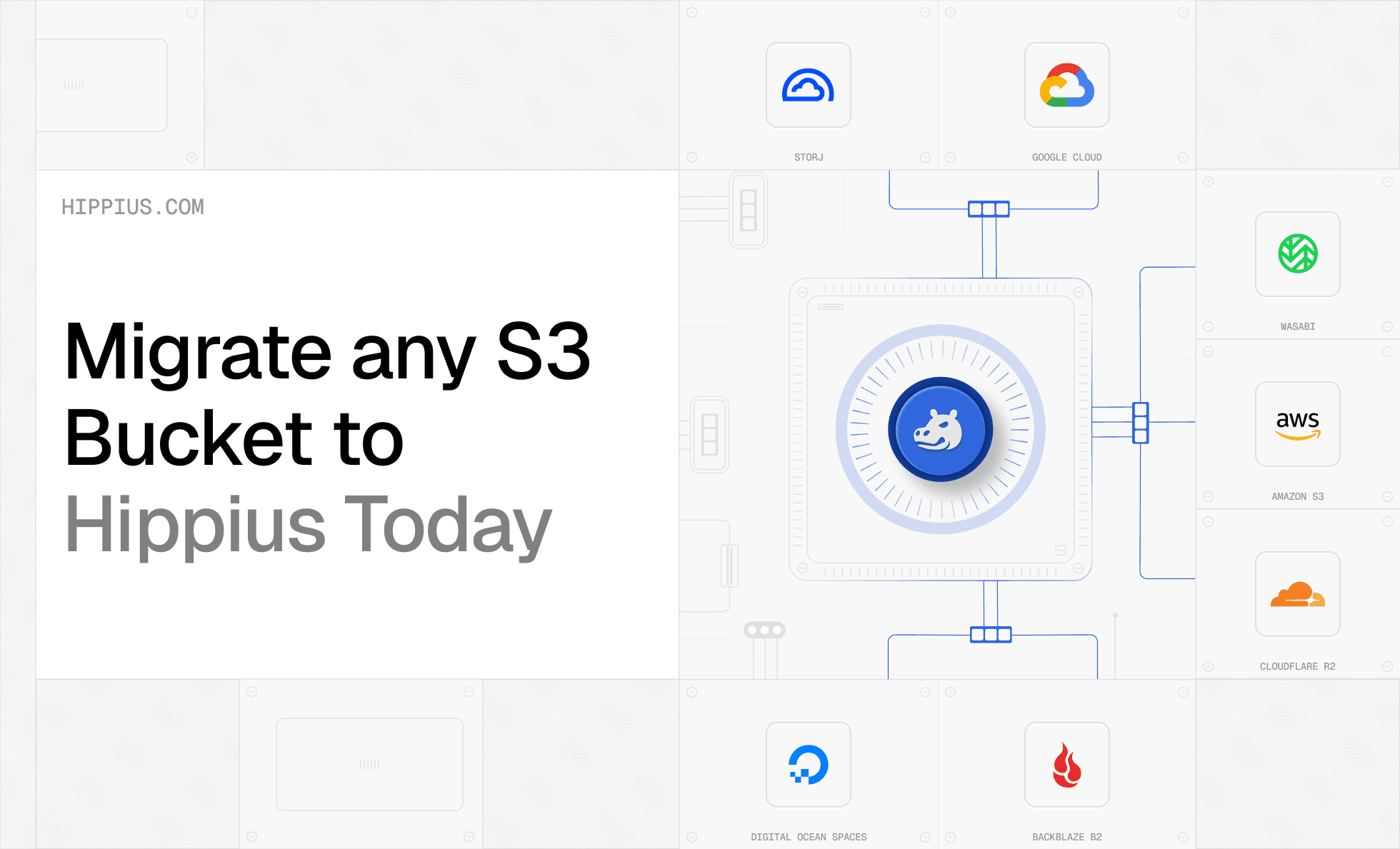
What's New: One-Click S3 Migration
You can now bring your files into Hippius without touching a line of code. Whether you're using AWS S3, Cloudflare R2, Backblaze B2, Google Cloud Storage, DigitalOcean Spaces, Storj, or any other S3-compatible provider, Hippius can migrate it seamlessly. Paste your access keys once, choose your buckets, and Hippius copies everything over server-side, with live progress the whole way.
No local tools to install. No rewritten integrations. Your existing S3 clients and tooling keep working exactly as they did before, because Hippius speaks the same standard S3 API your applications already use.
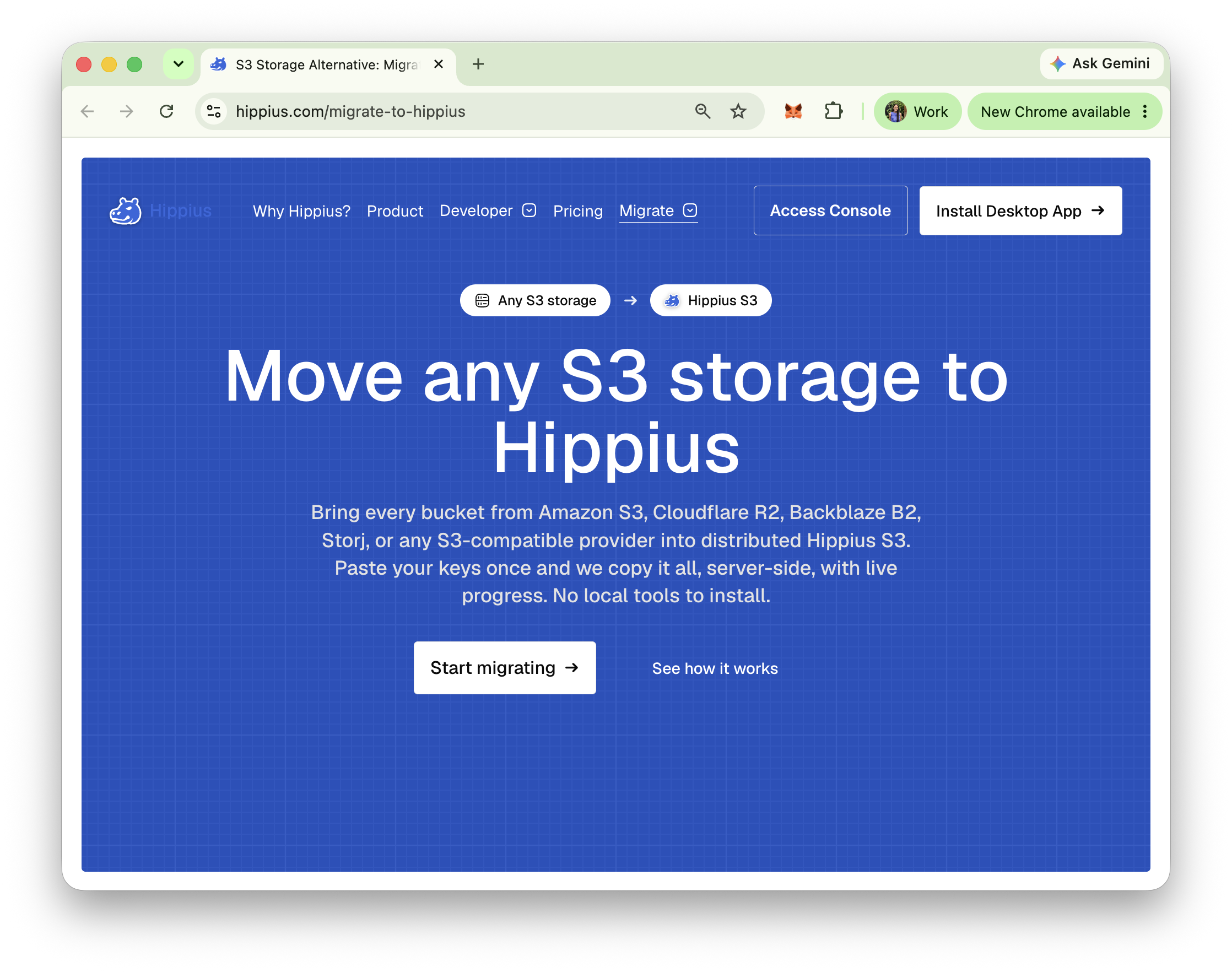
How the Migration Works
Getting your data into Hippius takes three steps:
- Get your S3 credentials. From your current provider, create an access key and secret. Read-only access is all that's needed for a migration.
- Paste them into Hippius. Open the Migrations tab in your Hippius console, choose your source provider, and pick the buckets you want to move. Or move all of them at once.
- Watch it migrate. Hippius copies every object into distributed S3 storage with live progress. Close the tab if you like. The migration keeps running.
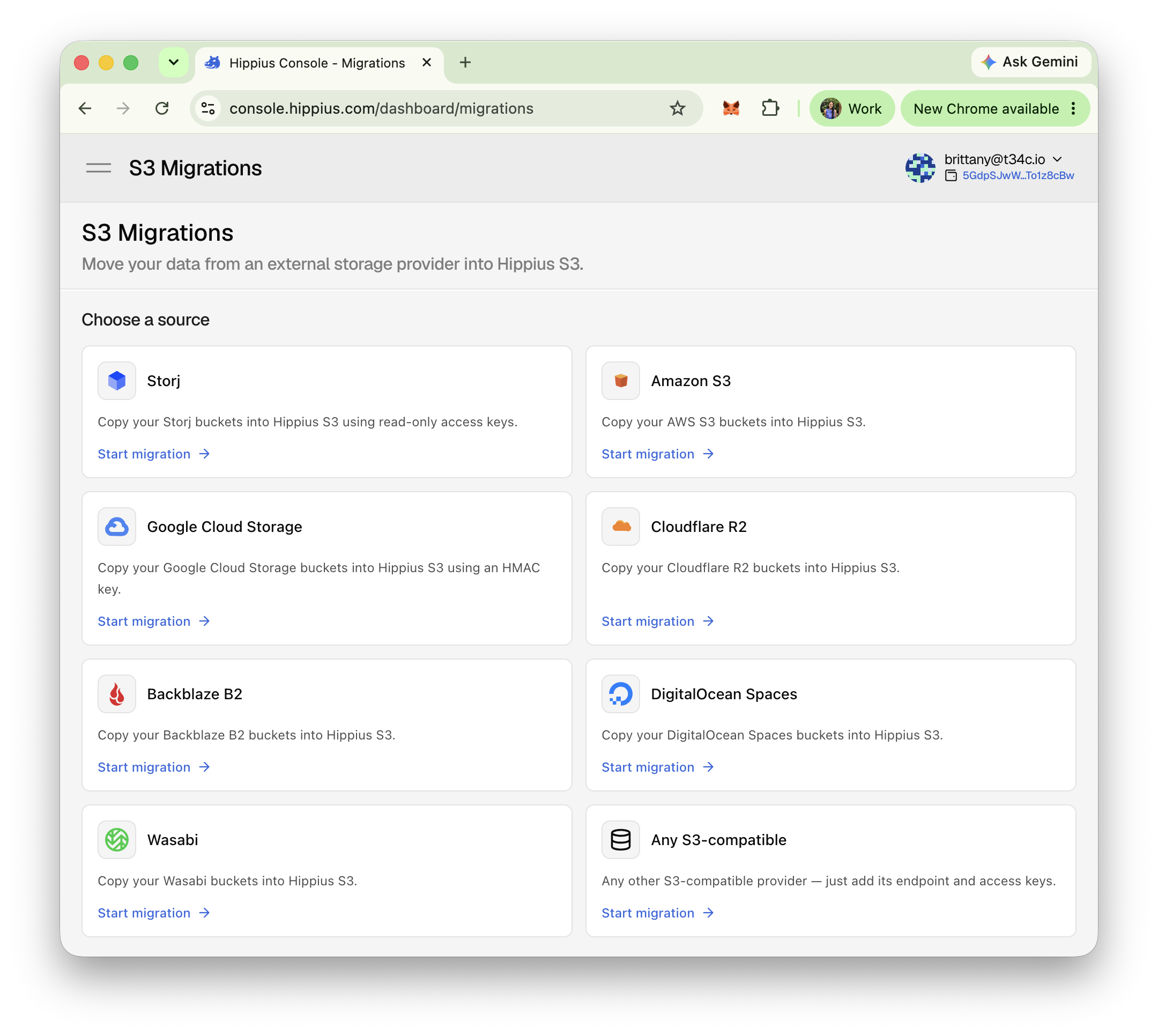
Hippius Console now supports one-click migrations from Storj, Amazon S3, Google Cloud Storage, Cloudflare R2, Backblaze B2, DigitalOcean Spaces, Wasabi, or any S3-compatible provider.
A few things worth knowing going in: nothing on your original provider is deleted, so your source data stays exactly where it is until you choose to remove it. The transfer runs entirely on Hippius's side, so there's no rclone or local tooling required. Your source credentials are used only for the copy and discarded afterward. Large migrations pick up where they left off if interrupted, so a hiccup never means starting over. And every migrated bucket arrives private. Hippius moves your data, not your permissions, so you decide how and when to share it again.
What You Gain from Migrating to Hippius
Migrating doesn't mean relearning your stack. Your access keys, buckets, and object paths carry over exactly as they were, and the same S3 API and tooling you already use keeps working with no code changes.
What changes is what you get on top of that. On Hippius, retrieving your own data costs nothing. There are no egress fees, ever. Every object is encrypted per bucket and spread across an independent network rather than sitting in a single provider's data center, while still speaking the same standard S3 API that Amazon itself documents for developers. And pricing is usage-based and transparent from the first hour, with no tiers to decode and no minimum commitment.
Why Now: A Moment of Change in Object Storage
Storage decisions used to be simple: pick a provider, ship your data, move on. Recent months have made a case for treating that choice more carefully. In late July 2026, Storj Labs filed for Chapter 11 bankruptcy protection, a court-supervised restructuring aimed at clearing legacy debt while, according to the company, keeping its network operating and services running without interruption.
Whatever happens next for Storj, moments like this are a useful reminder that portability matters. A storage provider you can leave easily, on standard S3 terms and without a bill for the privilege, is a different kind of commitment than one that locks your data in behind egress fees. That "roach motel" pattern, where getting data in is cheap but getting it out is expensive, has long been a defining feature of the major cloud providers. It's exactly what a standard-compatible, egress-free migration path is built to avoid.
Save Money by Migrating to Hippius
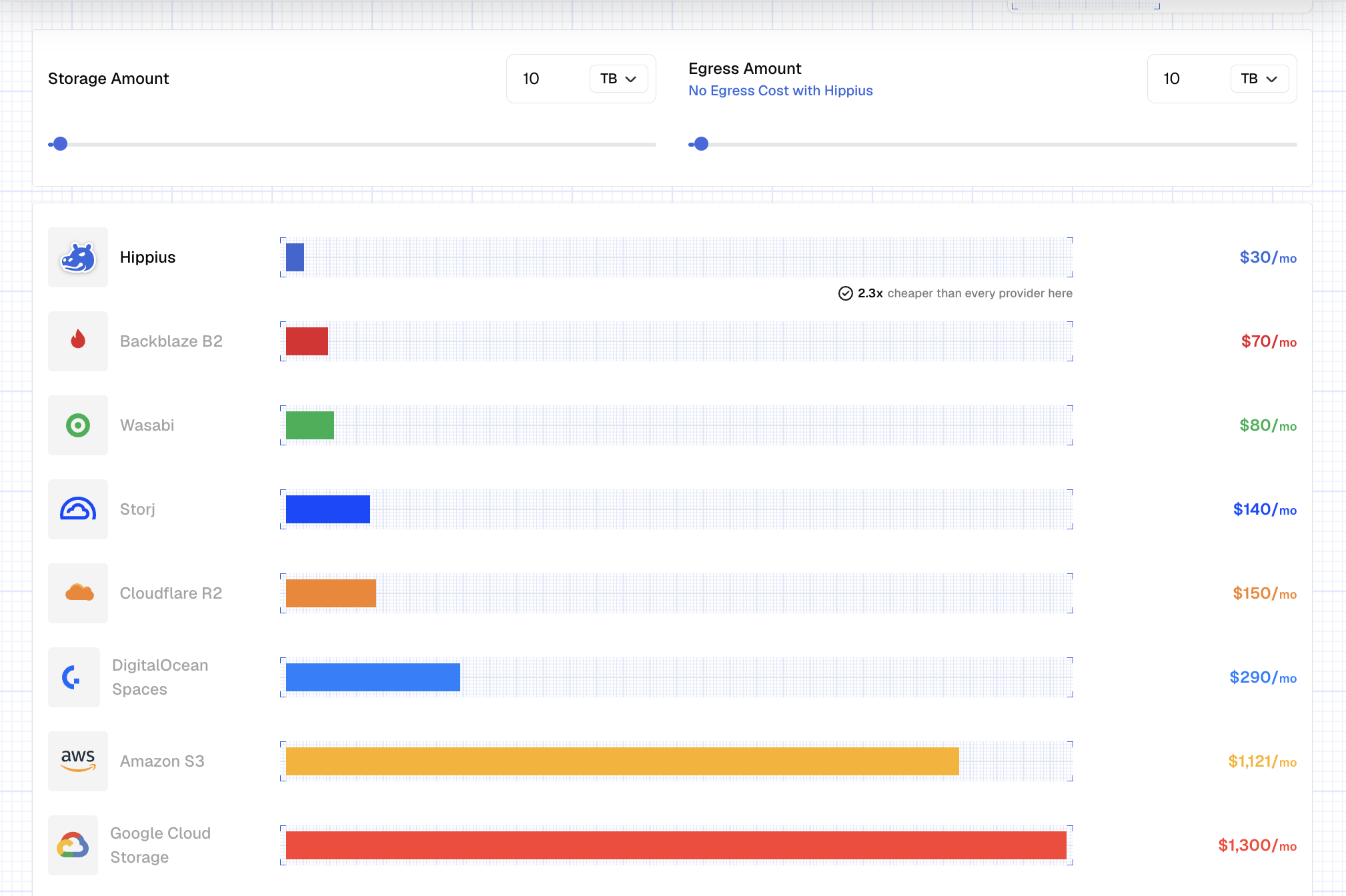
Egress fees are where most cloud storage bills quietly balloon. Cloudflare has documented this pattern in detail, showing that wholesale bandwidth costs have fallen sharply over the past decade while major providers' egress pricing has barely moved. Hippius takes a different approach: storage is billed at $0.003 per GB per month, calculated continuously from actual usage, and egress is always free.
Against Storj specifically, that difference adds up fast. On a typical workload of 5TB stored with 2TB of monthly downloads, Storj comes to roughly $34/month once egress is factored in, compared to about $14.87/month on Hippius, a saving of over 50%. Against AWS and Google Cloud, where egress rates run even higher, the gap is wider still. You can run your own numbers with the calculator at hippius.com/pricing.
Frequently Asked Questions
Do I need to rewrite any code to migrate?
No. Hippius uses the standard S3 API, so your existing SDKs, CLI tools, and integrations continue to work after the move.
Is my source data safe during migration?
Yes. Migrations are read-only against your original provider, and nothing is deleted there. You decide when, or if, to remove it afterward.
What if my migration is interrupted?
Large migrations resume from where they left off, so an interruption doesn't mean starting from zero.
Which providers can I migrate from?
Amazon S3, Cloudflare R2, Backblaze B2, Google Cloud Storage, DigitalOcean Spaces, Storj, Wasabi, or any other S3-compatible provider.
Get Started
Wherever your buckets live today, moving them onto distributed, verifiable storage with no egress fees now takes a few clicks instead of a migration project. Head to the Hippius migration page to paste your keys and start your migration, or check hippius.com/pricing first to see exactly what you'll save.
About Hippius
Hippius is a distributed cloud platform built to give users a verifiable alternative to providers like AWS and Google Cloud. Files are encrypted and distributed across an independent network rather than held in a single provider's data center. Every storage claim, payment, and miner action is recorded on Hippius's own blockchain, so instead of asking users to trust the platform, Hippius lets them check it for themselves. On top of that foundation sits a full product suite: personal cloud storage, S3-compatible object storage with no egress fees, confidential computing on secure hardware, and a container and model registry for AI. Hippius runs as Subnet 75 on Bittensor and was built by The Nerve Lab.
Website | Discord | Twitter | Docs | Blog | Medium | Forum | Github