Minos has used Hippius since their inception, and has stayed on it through every round of its genomic variant-calling competition since. Minos is Subnet 107 on Bittensor: a network where miners compete to detect DNA mutations in synthetic genomes, moving the underlying data through Hippius's s3 compatible storage in large volumes to every miner taking part. That combination, large files and constant reads, is exactly where cloud storage bills tend to get out of hand. This case study covers the problem Minos was solving, how it uses Hippius day to day, and why it has stayed on the platform since the beginning.
The Challenge: Moving Large Genomic Files
Minos turns genomic variant calling, the process of finding DNA mutations in sequencing data, into a continuous, transparent competition. Every round, the platform generates a fresh synthetic genome with hidden mutations, and miners race to detect them using tools like GATK, DeepVariant, and bcftools before validators score the results against a known truth set.
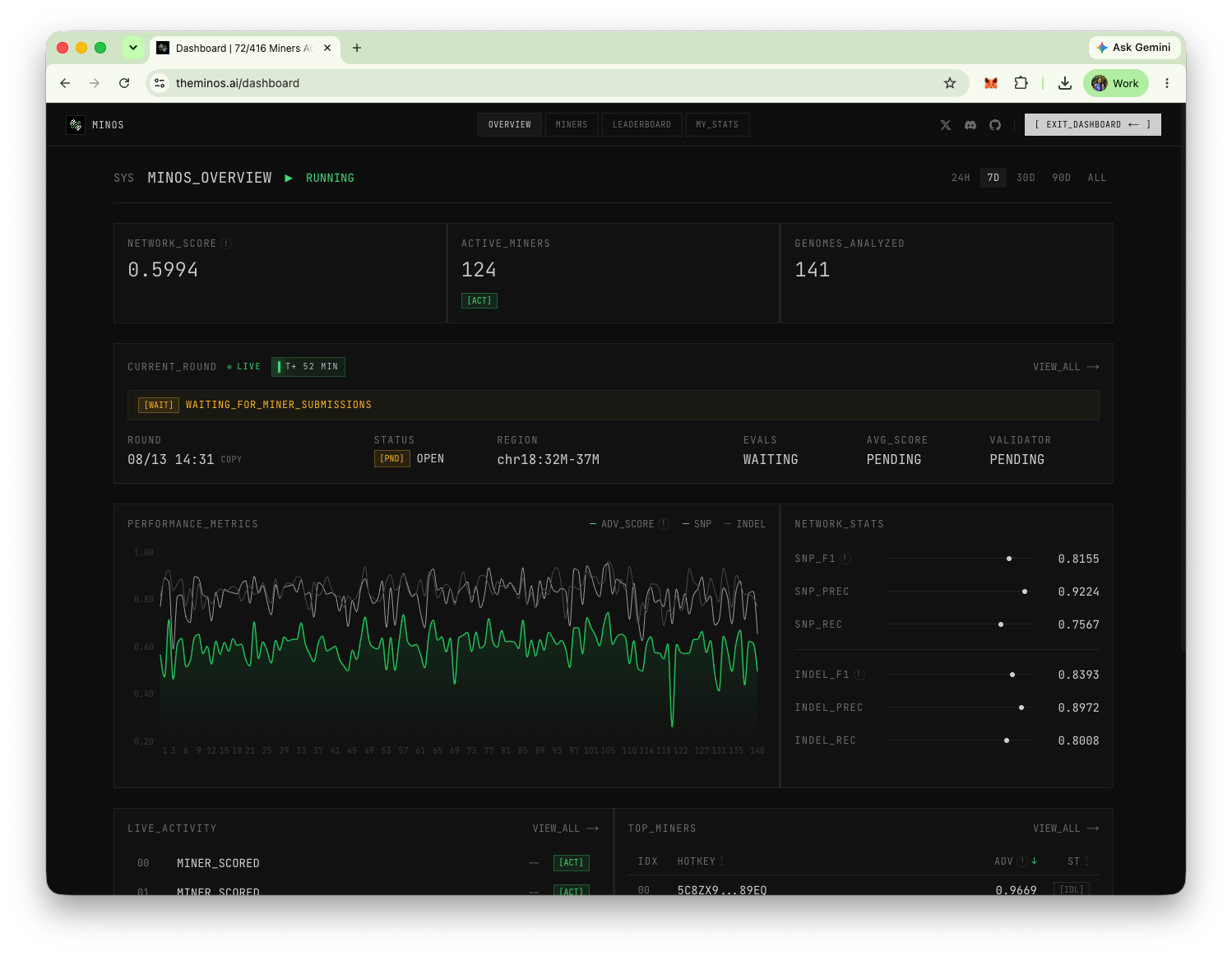
Running that loop means moving genomic files at real scale, and doing it constantly rather than as a one-off.
"We store our synthetic genomes on Hippius, and a subset gets shared directly with miners for every SN107 task. At that scale, storage costs and egress fees weren't a detail, they were something we had to get right from day one."
— Mamad Ahangari, Co-founder at Minos
That last part is what makes this a harder problem than typical archival storage. A dataset that only gets written once and rarely read is cheap almost anywhere. A dataset that gets pushed out to a fresh set of miners every round is a different kind of workload, and it reflects the data storage requirements for AI that more teams are having to plan around as datasets scale. It's exactly the kind where data egress fees turn a reasonable storage bill into an expensive one. Genome sequencing itself has gotten dramatically cheaper over the past two decades, per cost data tracked by the National Human Genome Research Institute. That drop has only shifted more of the real cost in genomic AI work onto the infrastructure that stores and moves the data.
The Role of Hippius in Minos
Hippius sits directly in Minos's task-coordination pipeline. According to Minos's own architecture documentation, the platform prepares BAM files carrying synthetic mutations, then generates temporary presigned URLs for transfer. Those files move across three storage backends running side by side: AWS S3, Cloudflare R2 and Hippius's s3 compatible storage. Validators pull the files down each round; miners run their variant-calling tools against them and submit results for scoring, all on a cycle tied to Bittensor's roughly 72-minute tempo.
Because Hippius's S3-compatible object storage works as a drop-in replacement for AWS S3, same API, same tooling, same presigned-URL pattern developers already use, Minos didn't need to rebuild its file-conveyance layer to add it. Data is encrypted at rest, per bucket, the same general model used by AWS KMS or Google CMEK. That means the storage layer meets the same baseline expectations as any object storage a genomics team would already be running. Every storage operation on Hippius is also recorded on its own blockchain, visible on the public Hipstats explorer. That gives the storage layer the same kind of independent verifiability that Minos's own scoring system is built around: neither team is asking anyone to just take its word for it.
Why Minos Chose an S3-Compatible Alternative to AWS
Minos has used Hippius since its own launch on Bittensor. A few things made it a fit for a workload that pushes large files out to a new set of miners every round, beyond generic object storage for AI teams looking for somewhere to park files:
- No egress fees on repeat distribution. This is the specific cost that scales hardest with a "new genome, out to every miner, every 72 minutes" pattern, and the one Hippius removes entirely.
- Drop-in S3 compatibility. Same API, same tooling, same presigned-URL pattern already built into Minos's pipeline, so adding Hippius meant no rework to the file-conveyance layer.
- A hedge, not a migration. Running Hippius alongside AWS and Cloudflare rather than instead of it, let Minos de-risk its cost structure without a disruptive, all-at-once switch.
- Verifiability that matches Minos's own philosophy. Every storage operation on Hippius is recorded on-chain and checkable on Hipstats, which fits naturally with a subnet built around continuous, independently verified scoring rather than self-reported accuracy.
That's also the shape of the decision most developers weighing amazon s3 alternatives eventually land on: not a full migration on day one, but adding a provider that removes the specific cost that hurts most, and proving it out from there.
The Result: Storage That Held Up
Minos has run on Hippius from the beginning and in the team's words, has stayed because it immediately satisfied their requirements:
"Hippius has simply worked for us since day one. We've been very happy with both the service and our overall experience."
— Mamad Ahangari, Co-founder at Minos
For a subnet that runs a new data-heavy round every 72 minutes, that kind of steady, unremarkable reliability is the actual goal. Minos hasn't had to reconsider its storage layer as it has scaled its round cadence and miner base. That's precisely what a genomics workload built on frequent, large data transfers needs from its infrastructure.
Teams facing the same combination of large files and constant reads can see current s3 compatible storage pricing, with no egress fees factored in, on the Hippius pricing page.
Ready to move large-scale AI data on storage that doesn't charge you to use it? See what Hippius can do for your infrastructure
About Minos
Minos is operating a genomic variant-calling network on Bittensor Subnet 107. Miners compete to detect DNA mutations from sequencing data with clinical-grade precision, and validators score every submission against gold-standard truth sets using industry standard validation guidelines. That replaces genomics' historical reliance on self-reported lab accuracy with continuous, independently verified benchmarking at scale.
About Hippius
Hippius is a distributed cloud platform built to give users a verifiable alternative to providers like AWS and Google Cloud. Files are encrypted and distributed across an independent network rather than held in a single provider's data center. Every storage claim, payment, and miner action is recorded on Hippius's own blockchain, so instead of asking users to trust the platform, Hippius lets them check it for themselves. On top of that foundation sits a full product suite: personal cloud storage, S3-compatible object storage with no egress fees, confidential computing on secure hardware, and a container and model registry for AI. Hippius was built by The Nerve Lab.
Website | Discord | Twitter | Docs | Blog | Medium | Forum | Github