Updated 3 November 2026. Hippius Object Storage is the cheapest S3-compatible storage in this comparison: $6 per TB a month with no egress or request fees, so storing 10 TB and reading all of it back costs $60 a month, less than Backblaze B2 ($69.50), Wasabi ($79.90) and Cloudflare R2 ($149.85), against $1,121 on Amazon S3, at list prices checked on 3 November 2026. Hippius does not yet apply lifecycle rules, and it has no S3 Select or event notifications, so if your setup depends on those, check before you move.
| Provider | Storage per TB | Egress to the internet | 10 TB stored + 10 TB read | Best for | Checked |
|---|---|---|---|---|---|
| Hippius Object Storage | $6 | Free | $60 | Keeping your S3 tools and reading your data often | 3 Nov 2026 |
| Backblaze B2 | $6.95 | Free up to 3x stored, then $0.01/GB | $69.50 | Backups with modest read-back | 3 Nov 2026 |
| Wasabi | $7.99 | Free up to 1x stored | $79.90 | Storage-heavy data kept 90 days or more | 3 Nov 2026 |
| Cloudflare R2 | $15 | Free | $149.85 | Public files for teams on Cloudflare | 3 Nov 2026 |
| DigitalOcean Spaces | $5 a month for 250 GiB, then $0.02/GiB¹ | 1 TiB included, then $0.01/GiB | $289.76 | Small projects already on DigitalOcean | 3 Nov 2026 |
| Azure Blob Storage | $18.40 (Hot, LRS, East US 2) | 100 GB free, then $0.087/GB | $1,045.30 | Teams already on Microsoft Azure | 3 Nov 2026 |
| Amazon S3 | $23 (Standard, US East) | 100 GB free, then $0.09/GB | $1,121 | Teams deep in the AWS ecosystem | 3 Nov 2026 |
| Google Cloud Storage | $20 (Standard, us-central1) | 100 GB free, then $0.12/GiB | $1,387.90 | Analytics teams using BigQuery | 3 Nov 2026 |
10 TB stored and 10 TB read back to the internet in one month, at each provider's published list price, before request charges and counting 1 TB as 1,000 GB. Notes on each provider's figures are at the end of this post.
Table of Contents
- Why teams look for S3 alternatives in 2026
- What to check in an S3 alternative
- S3 alternatives compared
- Which S3-compatible storage has no egress fees?
- S3 alternatives for backups
- What does 10 TB cost on each provider?
- How to switch without downloading your data
- What changed since September
- Common questions about Amazon S3 alternatives
- The bottom line
- About Hippius
Why teams look for S3 alternatives in 2026
Amazon S3 set the API that nearly every storage tool now speaks, and its feature set runs deep. The friction is usually the bill. Storing data is cheap; reading it back is where the cost grows. On Amazon's S3 pricing page, data transfer out to the internet costs $0.09 per GB for the first 10 TB each month, after 100 GB free. Serve 10 TB to your users and that line comes to $891, close to four times the $230 it costs to store the same 10 TB.
Regulation only fixes part of this. Under the EU Data Act, providers can no longer charge switching fees, including egress for moving to another provider, from 12 January 2027. That removes the cost of leaving. Everyday egress, for serving your own data to your own users, is outside the ban, so the useful question for 2026 is what you will pay every month to use your data wherever it ends up.
What to check in an S3 alternative
Most roundups rank providers by storage price per GB, but that is rarely the number that decides the bill. Start with how much data you read back each month, then work through the rest:
- Read-back volume. Egress is charged per GB on the hyperscalers, free up to a limit on Backblaze B2 and DigitalOcean Spaces, free on Hippius and Cloudflare R2, and free on Wasabi while monthly downloads stay at or below what you store.
- Request fees. Cloudflare R2 and the hyperscalers charge per operation. Hippius, Backblaze B2 and Wasabi do not.
- Minimum storage duration. Wasabi bills pay-as-you-go storage for at least 90 days, so deleting data early still costs you the remainder.
- S3 feature coverage. Uploads and downloads work everywhere. Presigned URLs, versioning, Object Lock and lifecycle rules are where implementations differ, so check the ones your code relies on.
- How you would leave again. A provider that speaks the standard API lets you walk out with the same tools you walked in with.
S3 alternatives compared
Hippius Object Storage
Hippius S3-compatible storage costs $6 per TB a month on pay as you go, billed by the hour with no commitment, and charges nothing for egress, requests or retrieval, with no minimum object size. If you would rather have a flat bill, the Pro plan is $53 a month for 10 TB, Business $245 for 50 TB and Enterprise $465 for 100 TB, and from 250 TB the price goes as low as $4 per TB on request. The full breakdown is on the Hippius Object Storage pricing page.
If a tool speaks S3, it works with Hippius: the AWS CLI, rclone, boto3, the AWS SDKs, MinIO clients, Cyberduck, Duplicati and Nextcloud. Switching means changing the endpoint, the region and your keys. Files can be up to 5 TB, video streams straight from a bucket with seeking, and versioning, Object Lock and legal holds are all supported. Every object is encrypted at rest under its own key, wrapped per bucket and sealed by a hardware security module, and each object is sharded across independent nodes, so it still rebuilds when part of the network is offline.
Two things set it apart from most of this list. The built-in S3 migration copies your buckets server-side from a read-only key, and the S3 CDN can serve a bucket from cache nodes in France and Australia, at $0.010 per GB delivered from France, with a spend cap on every zone. It is how Vidaio cut its storage costs by 50% after switching.
What it does not do yet: lifecycle rules are accepted but not applied, so nothing expires automatically, and there is no S3 Select, no event notifications and no virtual-hosted bucket URLs. There is one S3 region, with replication across the network handled automatically, and bucket policies can only make reads public. The full list is in the S3 compatibility matrix.
Backblaze B2
Backblaze B2 costs $6.95 per TB a month, with free API calls and no minimum file size or storage duration. Egress is free up to three times your average stored data, then $0.01 per GB, which covers most backup and archive workloads. Object Lock is supported through its S3-compatible API. Annual capacity pricing and the B2 Overdrive tier, from $15 per TB with unlimited egress on a multi-petabyte commitment, sit on top. The catch is read-heavy use: a workload that reads back more than three times what it stores starts paying per GB.
Wasabi
Wasabi charges $7.99 per TB a month on pay as you go, with no fees for egress or API requests. The free egress has a condition: Wasabi's FAQ says monthly downloads should stay at or below the amount you store, and regularly exceeding that can get the service limited or suspended. There are billing conditions too: storage is billed for at least 90 days per object, and there is a minimum monthly charge tied to 1 TB. That makes it a good fit for data that stays put, and a poor one for short-lived files you rewrite often. Reserved capacity in 1, 3 or 5-year terms brings the price down further from 25 TB.
Cloudflare R2
Cloudflare R2 charges $0.015 per GB-month, about $15 per TB, and nothing for egress. Operations are billed separately: $4.50 per million writes and $0.36 per million reads after a free tier, so a site serving millions of small files a day can see a request bill larger than its storage bill. R2 fits best when the files are public and the rest of the stack already runs on Cloudflare Workers. Retention uses R2's own bucket lock rules, set by prefix.
DigitalOcean Spaces
DigitalOcean Spaces starts at $5 a month for 250 GiB of storage and 1 TiB of outbound transfer, then $0.02 per GiB stored and $0.01 per GiB transferred. A built-in CDN is included. For a small project already on DigitalOcean it is simple, but at 10 TB the per-GiB storage rate makes it more than four times the price of Hippius. Object Lock does not appear in its S3 compatibility documentation, so check before using it for immutable backups.
Azure Blob Storage
Azure Blob Storage Hot tier costs $0.0184 per GB a month on locally redundant storage in East US 2, and internet egress is $0.087 per GB after the first 100 GB. It makes sense when the rest of your workload runs on Azure. Azure uses its own Blob API, so S3 tools need a gateway or code changes.
Amazon S3
Amazon S3 Standard costs $0.023 per GB a month for the first 50 TB in US East, and egress to the internet is $0.09 per GB for the first 10 TB after 100 GB free. Request and retrieval charges come on top. Nothing on this list matches its feature depth (S3 Select, event notifications, replication, every storage class), so if your architecture depends on those, staying may be the right call.
Google Cloud Storage
Google Cloud Storage Standard costs $0.020 per GB a month in us-central1, and data transfer to the internet is $0.12 per GiB up to 10 TiB, with 100 GB a month free from North America. That makes it the most expensive row here for read-heavy workloads. Its strength is the BigQuery and Google Cloud AI tooling around it.
Self-hosted: MinIO or Ceph
If you want full control, MinIO and Ceph both run the S3 API on your own hardware. There is no provider fee, but you buy the disks, run the upgrades and carry the on-call, and egress is whatever your hosting charges.
Which S3-compatible storage has no egress fees?
As of 3 November 2026, Hippius Object Storage and Cloudflare R2 charge nothing for egress to the internet, Wasabi charges nothing while monthly downloads stay at or below what you store, and Backblaze B2 charges nothing up to three times the data you store. Each one has a catch:
- Hippius Object Storage has no egress, request or retrieval fees and no minimum duration; lifecycle rules are not applied yet.
- Cloudflare R2 bills every read and write as an operation after the free tier.
- Wasabi expects monthly downloads to stay at or below what you store, and regularly going over can get the service limited or suspended; it also bills each object for at least 90 days and charges a 1 TB minimum.
- Backblaze B2 starts charging $0.01 per GB once egress passes three times your stored data.
DigitalOcean Spaces includes 1 TiB of transfer in its $5 plan, which is free egress for small buckets and $0.01 per GiB after that.
On price and egress together, as of 3 November 2026 Backblaze B2 costs $6.95 per TB with egress free up to 3x stored, Cloudflare R2 costs about $15 per TB with free egress but charges per operation, and DigitalOcean Spaces costs $5 a month for 250 GiB plus $0.02 per extra GiB, with 1 TiB of transfer included. All three accept the same S3 tools, so the choice comes down to how much you store and how often you read it.
S3 alternatives for backups
Backups are where egress hurts most, because the bill arrives on the day you restore. Restoring 10 TB from Amazon S3 costs $891 in transfer alone at list price, while the same restore from Hippius Object Storage, Wasabi or Cloudflare R2 costs nothing in egress, and from Backblaze B2 costs nothing as long as it stays under three times what you store.
Rotating backups also run into minimum storage durations. A nightly backup kept for 14 days is billed for 90 on Wasabi, while Hippius, Backblaze B2 and Cloudflare R2 Standard have no minimum.
For ransomware protection you want immutable copies. Hippius supports S3 Object Lock in governance and compliance modes, plus legal holds and bucket default retention, as described in its Object Lock guide. Backblaze B2, Wasabi and Amazon S3 support S3 Object Lock as well, while Cloudflare R2 uses its own bucket lock rules. Backup tools such as Duplicati and rclone work with Hippius directly; the Duplicati setup guide covers the settings.
If you are looking for an Amazon S3 Glacier alternative, the trade-off is different: Glacier is cheap to store and slow and costly to restore. Hot storage with no egress fees, like Hippius at $6 per TB, costs more to hold but nothing extra to restore, which suits backups you actually expect to use.
What does 10 TB cost on each provider?
The scenario is one month: 10 TB stored and 10 TB read back to the internet, at each provider's list price on 3 November 2026, before request charges, counting 1 TB as 1,000 GB and applying each provider's free allowances.
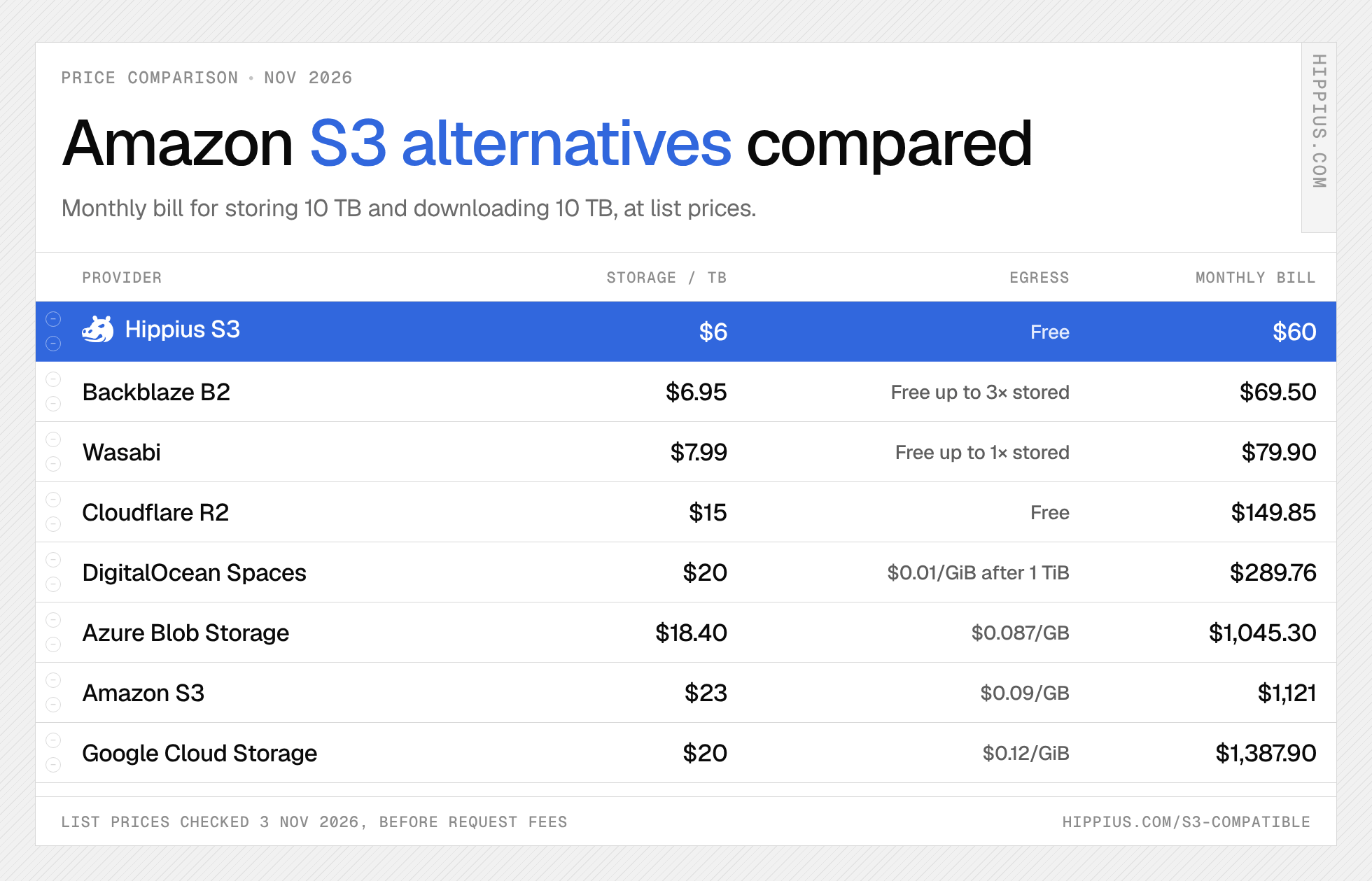
Storing 10 TB on Amazon S3 Standard and reading 10 TB back to the internet costs about $1,121 a month at US East list prices on 3 November 2026, against $60 on Hippius Object Storage.
- Hippius Object Storage: 10 TB × $6 = $60. Egress $0. Total $60 (or $53 on the Pro plan, which includes 10 TB).
- Backblaze B2: 10 TB × $6.95 = $69.50. 10 TB of egress is within the free 3x allowance. Total $69.50.
- Wasabi: 10 TB × $7.99 = $79.90. Egress $0. Total $79.90.
- Cloudflare R2: (10,000 GB − 10 GB free) × $0.015 = $149.85. Egress $0. Total $149.85, before operations.
- DigitalOcean Spaces: $5 + (10,000 − 250 GB) × $0.02 = $200 storage; (10,000 − 1,024 GB) × $0.01 = $89.76 transfer. Total $289.76.
- Azure Blob Storage: 10,000 GB × $0.0184 = $184 storage; (10,000 − 100 GB) × $0.087 = $861.30 egress. Total $1,045.30.
- Amazon S3: 10,000 GB × $0.023 = $230 storage; (10,000 − 100 GB) × $0.09 = $891 egress. Total $1,121.
- Google Cloud Storage: (10,000 − 5 GB free) × $0.020 = $199.90 storage; (10,000 − 100 GB) × $0.12 = $1,188 egress. Total $1,387.90.
On 3 November 2026 list prices, the cheapest S3-compatible storage for 10 TB of backups or media read back once a month is Hippius Object Storage at $60, followed by Backblaze B2 at $69.50 and Wasabi at $79.90. For the three providers most often compared with each other, the same 10 TB costs $69.50 a month on Backblaze B2, $149.85 on Cloudflare R2 and $289.76 on DigitalOcean Spaces at list prices on 3 November 2026.
Read the data back more than three times a month and Backblaze B2 starts charging egress, while Hippius and Cloudflare R2 stay flat.
How to switch without downloading your data
Moving object storage usually means downloading every object and uploading it again, paying egress and waiting on your own bandwidth. Hippius's built-in tool lets you migrate S3 buckets server-side instead. You give it a read-only key for your current bucket, whether that is on Amazon S3, Google Cloud Storage, Cloudflare R2, Backblaze B2, DigitalOcean Spaces, Wasabi or any other S3 endpoint, and the copy runs on Hippius's side.
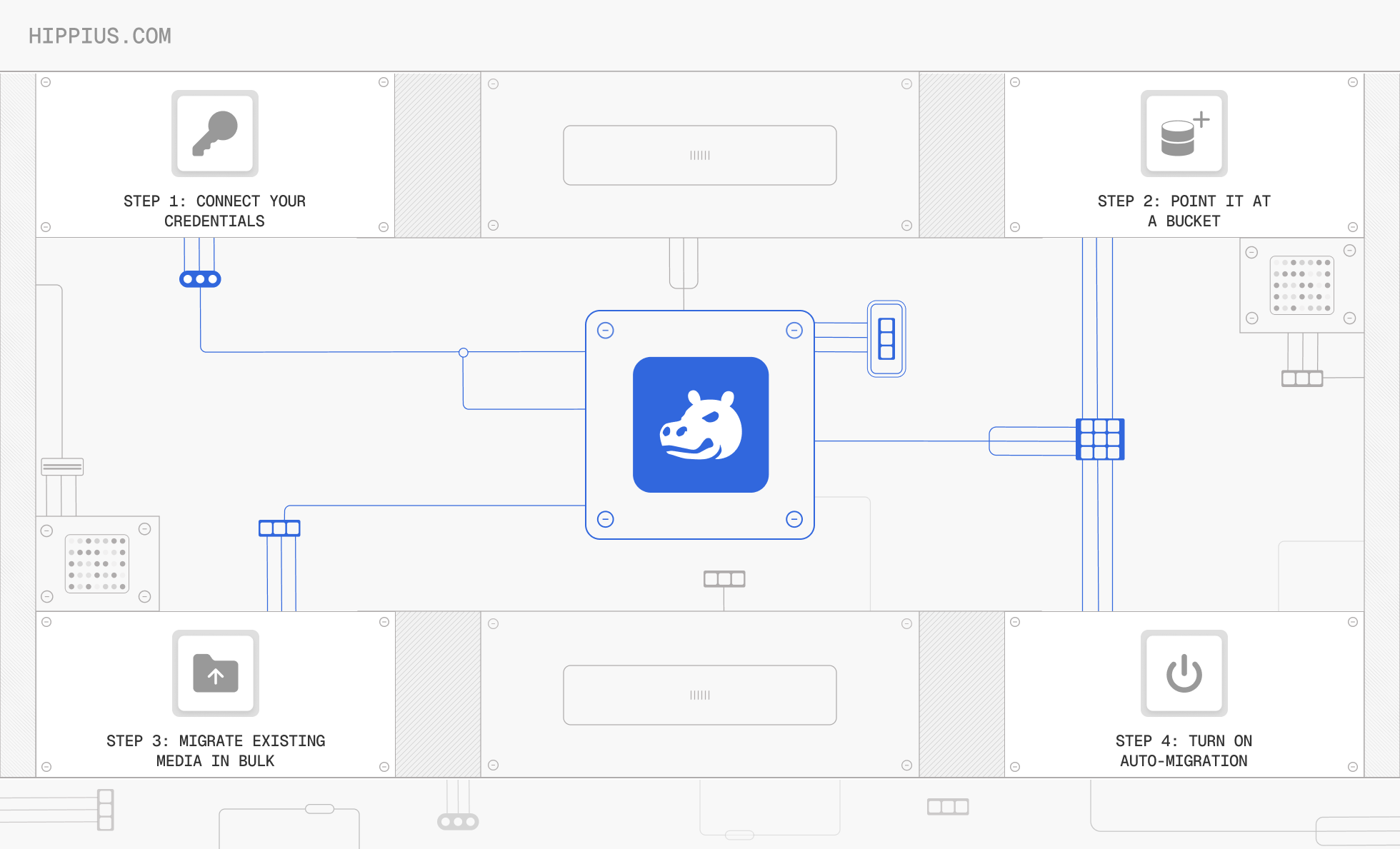
- Create a read-only key at your current provider.
- Open S3 Migrations in the Hippius console, paste the key and choose which buckets to bring over.
- Point your tools at Hippius once the copy finishes.
Your source is never touched, and nothing is moved or deleted there. If a copy is interrupted, it picks up where it left off. Migrated buckets arrive private, so you decide what to share again. Once a bucket has landed, you can put a CDN zone in front of it to serve its files from cache nodes in France and Australia. Hippius Object Storage, Backblaze B2, Wasabi, Cloudflare R2 and DigitalOcean Spaces all speak the S3 API, so switching between them usually means changing the endpoint, region and keys in your existing code. For a screen-by-screen version, see how to migrate S3 buckets to Hippius in a few clicks, or our walkthrough of Hippius S3 as a drop-in replacement for AWS S3.
What changed since September
This post first went up on 23 September 2026. Here is what has moved since.
- Hippius CDN launched on 26 October 2026, so a Hippius Object Storage bucket can now be served from cache nodes in France and Australia, with HTTPS on your own domain and a monthly spend cap per zone.
- Hippius lifecycle rules are still accepted but not applied as of 3 November 2026, so plan around automatic expiry for now.
- DigitalOcean Spaces is added to the comparison on 3 November 2026, since it is a common migration source.
- The table now shows storage price per TB and a 10 TB monthly cost (3 November 2026), with the date each row was checked.
- Google Cloud Storage egress is $0.12 per GiB for the whole first 10 TiB as of 3 November 2026; the September table gave that rate for the first TB only.
Common questions about Amazon S3 alternatives
What is the best alternative to Amazon S3?
It depends on how much data you read back. For most teams that read their data regularly, an S3-compatible provider with no egress fees is the better fit. On 3 November 2026, Hippius Object Storage costs $60 a month for 10 TB stored and 10 TB read back, against $1,121 on Amazon S3, and your existing S3 tools keep working.
Which S3 alternative has no egress fees?
As of 3 November 2026, Hippius Object Storage and Cloudflare R2 charge nothing for egress, Wasabi charges nothing while monthly downloads stay at or below what you store, and Backblaze B2 charges nothing up to three times your stored data. Hippius also has no request or retrieval fees and no minimum storage duration.
What is the cheapest S3-compatible storage?
At list prices on 3 November 2026, Hippius Object Storage is the cheapest S3-compatible storage in this comparison at $6 per TB a month with free egress, or $53 a month for 10 TB on the Pro plan. Backblaze B2 is $6.95 per TB with egress free up to 3x stored.
Is Amazon S3 free?
Amazon S3 is not free beyond a limited free tier for new accounts. You pay for storage, requests and data transfer out. Egress to the internet is free for the first 100 GB a month and $0.09 per GB after that for the first 10 TB in US East, as of 3 November 2026.
What is an egress fee?
An egress fee is a charge for moving data out of a cloud provider's network, such as when users download files, a backup restores or data moves elsewhere. Uploading is usually free. On Amazon S3 egress starts at $0.09 per GB; Hippius Object Storage charges no egress fees.
What is S3 compatible storage?
S3 compatible storage is object storage that uses the same API as Amazon S3, so tools and code written for S3, like the AWS CLI, rclone and boto3, work after a change of endpoint and keys. Feature coverage varies by provider, so check versioning, Object Lock and lifecycle rules against what you use.
Is there an Amazon S3 Glacier alternative?
Yes. For backups you expect to restore, hot storage with no egress fees often costs less overall than Glacier, because restores are free. Hippius Object Storage stores data at $6 per TB a month with Object Lock for immutable copies and no fee to read it back.
How do you clone an Amazon S3 bucket?
To clone a bucket within AWS, copy its contents to a new bucket with a command such as aws s3 sync s3://source-bucket s3://destination-bucket. To clone it to another provider, use a server-side migration. Hippius copies any S3 bucket into Hippius Object Storage from a read-only key, without downloading your data or touching the source.
Notes on the figures. All prices are published US list prices checked on 3 November 2026, before tax, volume discounts and request charges, with 1 TB counted as 1,000 GB. Hippius: Object Storage pricing, pay as you go at $0.006 per GB billed hourly; the Pro plan covers 10 TB for $53. Backblaze B2: B2 pricing, pay-as-you-go rate, egress free up to 3x average monthly storage. Wasabi: Wasabi pricing, pay as you go; 90-day minimum storage duration and a minimum monthly charge tied to 1 TB. Cloudflare R2: R2 pricing, Standard storage, 10 GB a month free; Class A and B operations not included. ¹DigitalOcean Spaces: Spaces pricing, billed in GiB; the 10 TB scenario counts each GB as one GiB for comparability. Azure: Blob Storage pricing for Hot LRS in East US 2 and bandwidth pricing from North America on Microsoft's network. Amazon S3: S3 pricing, US East (N. Virginia). Google Cloud Storage: Cloud Storage pricing, us-central1 Standard, with the Always Free 5 GB storage and 100 GB egress applied.
The bottom line
The storage price per TB is the smallest part of most S3 bills. Once you read your data back, egress decides the cost: 10 TB stored and read back costs $1,121 a month on Amazon S3 and $60 on Hippius Object Storage at 3 November 2026 list prices. If your setup does not rely on lifecycle expiry, S3 Select or event notifications, move your first bucket to Hippius Object Storage and keep using the tools you already have.
About Hippius
Hippius is a distributed cloud platform built to give users a verifiable alternative to providers like AWS and Google Cloud. Files are encrypted and distributed across an independent network rather than held in a single provider’s data center. Every storage claim, payment, and miner action is recorded on Hippius’s own blockchain, so instead of asking users to trust the platform, Hippius lets them check it for themselves. On top of that foundation sits a full product suite: personal cloud storage, S3-compatible object storage with no egress fees, a CDN that serves stored files from the edge, confidential compute on secure hardware, and a container and model registry for AI.
Website | Discord | Twitter | Docs | Blog | Medium | Forum | Github | LinkedIn