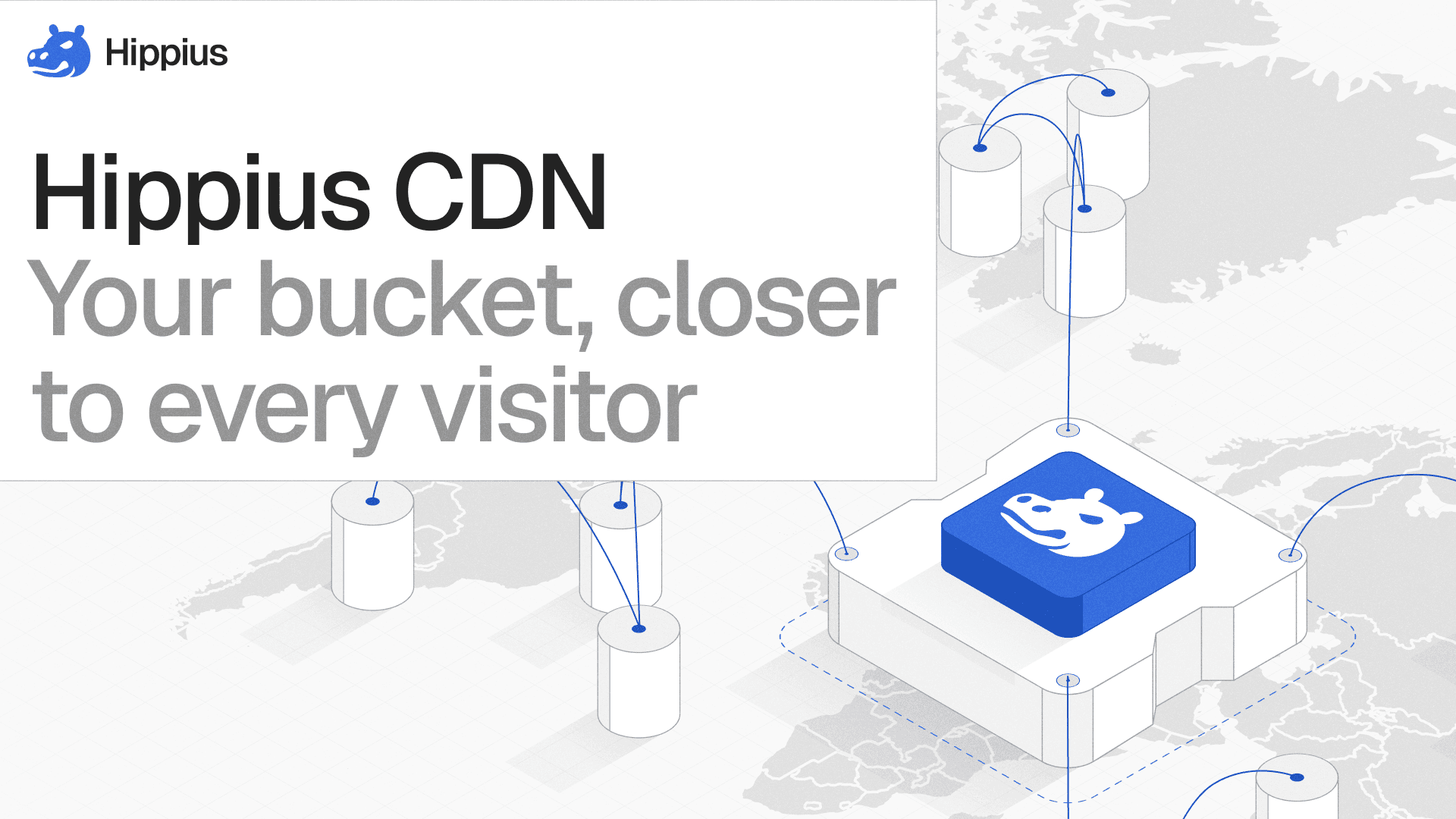
Hippius CDN is now live. It takes the files in your S3 Compatible bucket and delivers them to your visitors from edge locations close to them, over HTTPS, so websites, images, videos and downloads load faster wherever people are. It's an S3 CDN built into the same place you already store your files, with nothing extra to connect.
Pricing is just as simple. There's no plan to pick: you pay for what's delivered - you set a spend cap and delivery pauses when it hits your cap. If you already keep files in Hippius S3 compatible storage, this is how you put them in front of an audience.
Here's what launched, what it costs, and how to get started.
What is Hippius CDN?
When someone opens your website or loads an image, the file has to travel from wherever it's stored to their screen. The further it travels, the longer they wait. A content delivery network, or CDN, shortens that trip by keeping copies of your files in locations closer to your visitors. Google's developer guide to CDNs puts it simply: less distance means less waiting, and less strain on the place your files live.
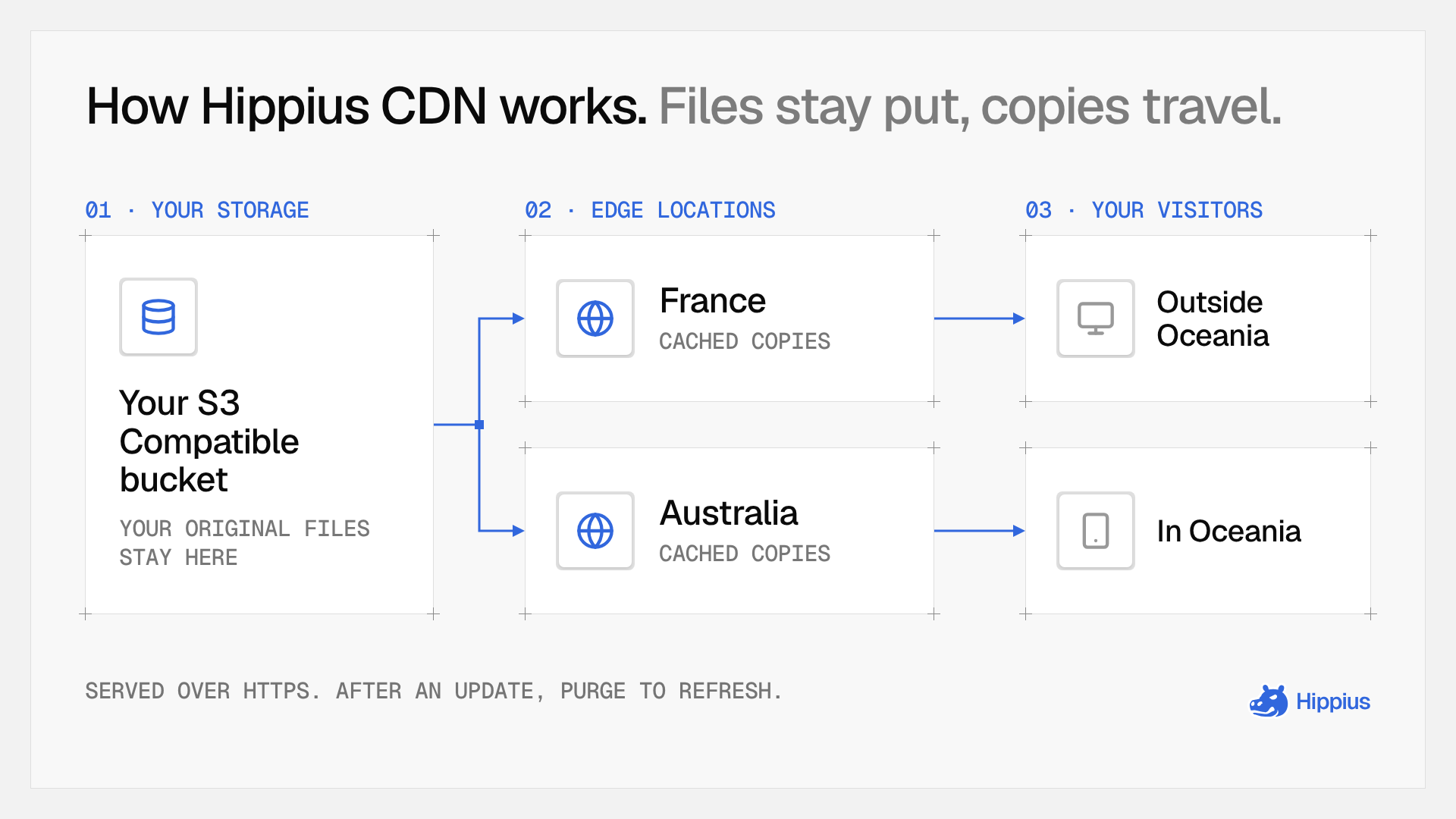
Hippius CDN brings that to your Hippius S3 Compatible buckets. It launches with edge locations in France and Australia, and every visitor is served from whichever is closest to them.
Your files don't move. They stay in your own bucket, and you keep managing them exactly as you do today. The CDN's only job is delivery.
What can you use it for?
Anything people load often is a good fit. At launch, that covers four main uses.
- Websites and web apps. Host a static website or a single-page app straight from a bucket, on your own domain.
- Images and video. Using a CDN for images is the most common case: product photos, galleries and blog media load quickly for visitors wherever they are, and so does video.
- App assets. The scripts, styles and fonts your app loads on every page get served from close by. If your app or API pulls them from another domain, built-in CORS settings let you choose which sites can use them. MDN's guide to CORS explains what that means if it's new to you.
- Downloads. Share installers, documents and datasets from a link on your own domain, without running a separate file server.
How much does Hippius CDN cost?
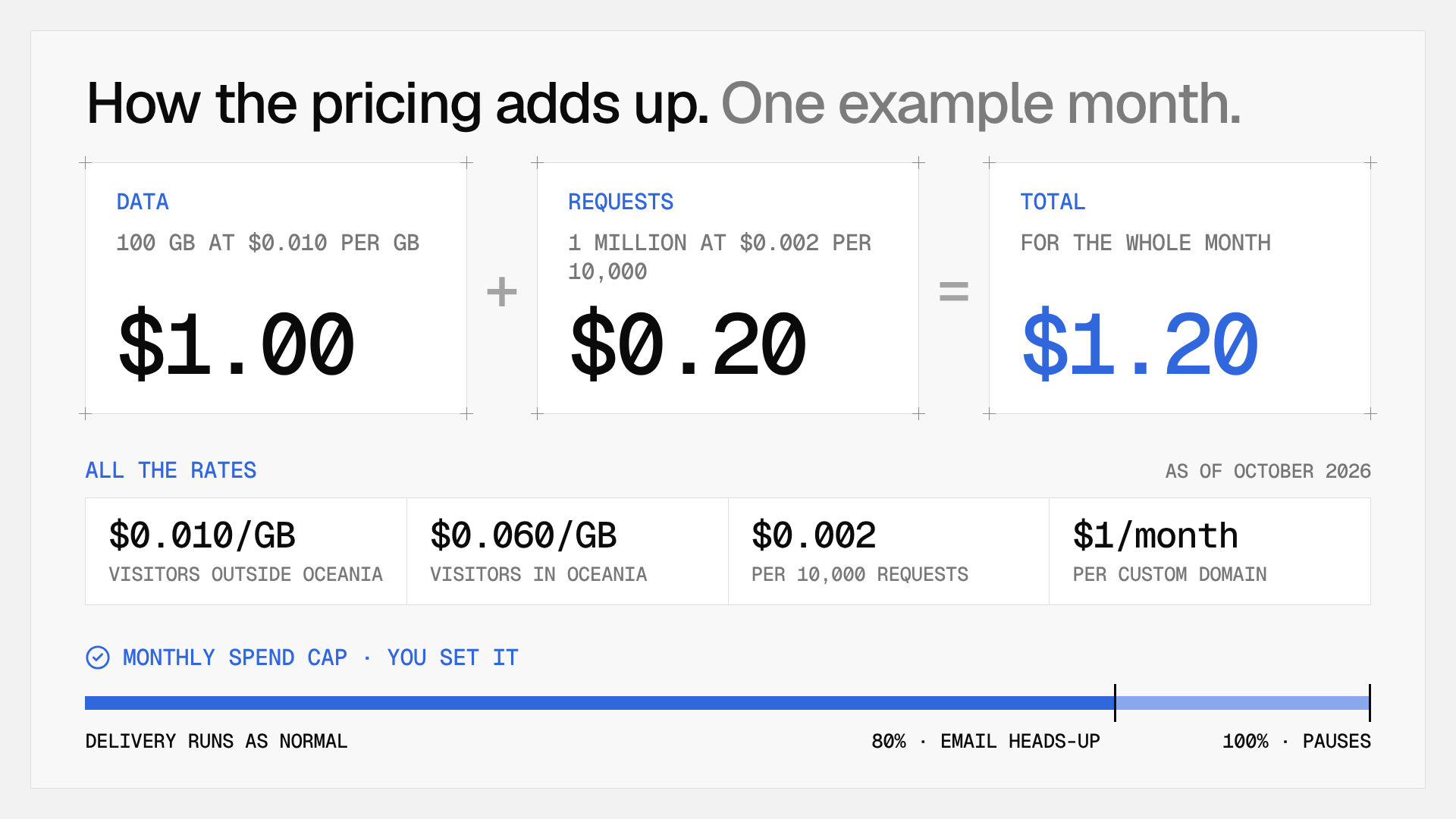
Hippius CDN is pay-as-you-go, with no tiers and no commitment. CDN pricing comes down to four numbers:
| What you pay for | Price |
|---|---|
| Data delivered to visitors outside Oceania | $0.010 per GB |
| Data delivered to visitors in Oceania | $0.060 per GB |
| Requests, all regions | $0.002 per 10,000 |
| Custom domain | $1 per month |
For a sense of scale, delivering 100 GB to visitors outside Oceania, with 1 million requests, costs $1.20.
Every setup also has its own monthly spend cap. You choose the number, Hippius lets you know as you get close, and delivery pauses at the cap rather than running up a surprise bill. That's what makes it an affordable CDN in practice: low prices, and a ceiling you set yourself.
Full details are on the Hippius pricing page.
Set up an S3 CDN in three steps
Putting a CDN in front of your storage often means signing up for a second service and connecting the two. With Hippius, the CDN sits in the same console as your buckets, so getting started takes a few minutes.
- Pick a bucket. Choose the bucket you want to share, or just one folder inside it.
- Create a zone. A zone is your CDN setup for that bucket. Give it a name and a spend cap, and it's live.
- Point your domain. Add your own domain with a quick change at your domain provider, and Hippius takes care of HTTPS.
One thing worth knowing: everything in the bucket or folder you choose becomes publicly viewable. So create the zone on the specific folder you want to share, rather than on a bucket that also holds private files.
Edge caching you stay in control of
Edge caching is the part that does the speeding up: once a file has been requested, a copy waits at the edge for the next visitor. Hippius CDN handles this for you by default, and gives you the controls to adjust it when you need to.
- Cache rules decide what stays at the edge and for how long.
- Purge clears the old copy after you update a file, so visitors get the new version, usually in under a minute.
Common questions about Hippius CDN
What is a CDN cache?
A CDN cache is a copy of a file kept at an edge location after someone first requests it. The next nearby visitor gets that copy straight from the edge, instead of waiting for it to come all the way from the original storage. Cached copies don't update on their own when you change a file. With Hippius CDN, you purge the old copy, and visitors get the new version, usually in under a minute.
Is S3 a CDN?
No. S3 is storage: it holds your files in one place. A CDN sits in front of that storage and delivers copies from locations closer to your visitors. With Hippius, the two work together. Your files live in Hippius S3 Compatible storage, and Hippius CDN delivers them.
Do I need a CDN for my website?
It depends on who's visiting. Downloading straight from Hippius S3 Compatible storage carries no egress fees, and for backups or occasional downloads, that's often all you need. A CDN is worth it when files are public and loaded often, like a website, an image library or app files, especially when your visitors are spread across different parts of the world.
Does a CDN affect SEO?
Not directly. A CDN doesn't give a page a ranking boost on its own, but it can help pages load faster, and load speed is part of Core Web Vitals, which Google's page experience documentation says its ranking systems use. Google is also clear that good scores don't guarantee a top spot, so think of a CDN as one part of a fast site rather than an SEO shortcut.
Try Hippius CDN today
Hippius CDN is live now for every account. Open CDN in the Hippius console, pick a bucket, set a spend cap you're comfortable with, and your files can be serving from the edge in minutes. When you want the full walkthrough, the CDN docs have every detail.
About Hippius
Hippius is a distributed cloud platform built to give users a verifiable alternative to providers like AWS and Google Cloud. Files are encrypted and distributed across an independent network rather than held in a single provider's data center. Every storage claim, payment, and miner action is recorded on Hippius's own blockchain, so instead of asking users to trust the platform, Hippius lets them check it for themselves. On top of that foundation sits a full product suite: personal cloud storage, S3-compatible object storage with no egress fees, confidential compute on secure hardware, and a container and model registry for AI. Hippius runs as Subnet 75 on Bittensor and was built by The Nerve Lab.
Website | Discord | Twitter | LinkedIn | Docs | Blog | Medium | Forum | Github