Cascade now runs its training records, model releases and production database on Hippius, and pays about 66% less for storage and about 33% less for its database than it did before. The team trains open time-series foundation models in public, so its object storage for AI training has a second job: it is the record anyone taking part can check.
This case study covers what Cascade is building, what its stack needed to do, why the team moved to Hippius, and how multiple Hippius services now fit together behind its training pipeline and forecasting API.
Key Metrics at a Glance
- S3 Object storage: ~66% saved after moving buckets to Hippius S3 Compatible storage
- Database: ~33% saved compared with its previous provider, Supabase
- 3 Hippius services in production: S3 Compatible storage, Hippius Hub and managed databases
- 2 more on the way: GitHub Actions runners and Confidential VMs
- One public, auditable log for everyone who contributes to or checks Cascade's results
What Is Cascade Building?
Cascade, built by TensorLink AI, has one goal: train the most capable time-series foundation model (TSFM) it can through open competition. Time-series models forecast how numbers change over time, from prices and energy demand to server load and sensor readings.
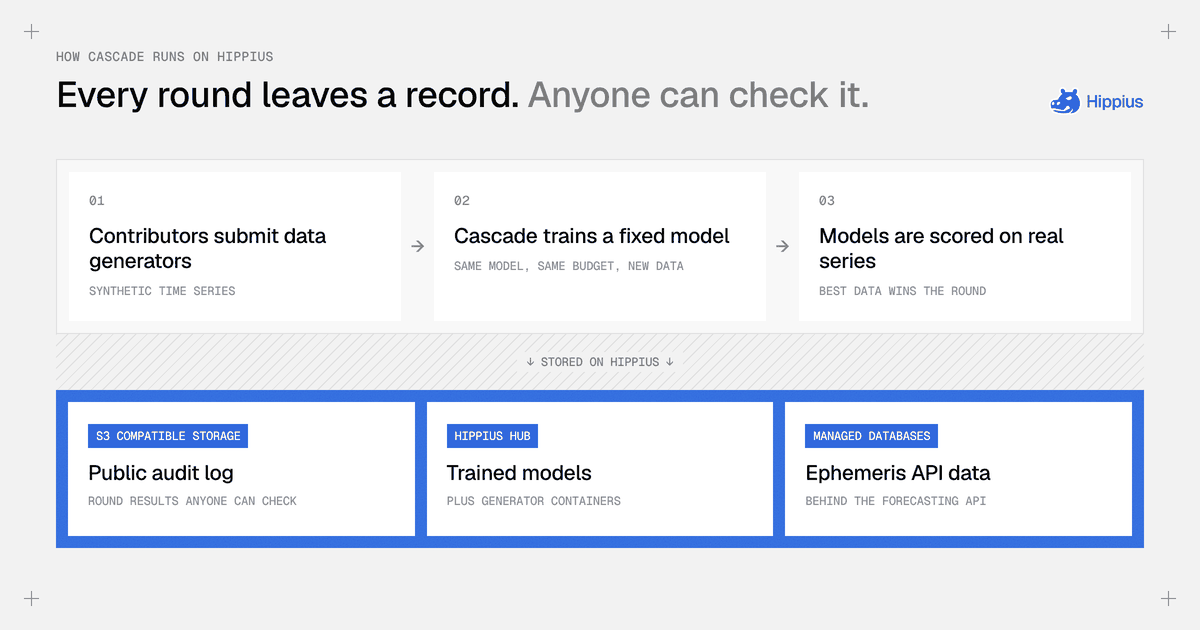
Most model competitions ask contributors to compete on model weights. Cascade asks them to compete on data. Contributors write generators that produce synthetic time series, and Cascade trains the same small, fixed forecaster from scratch on each one. That forecaster is a subnet-designed 1.2B-parameter Mixture of Experts model, aiming for state-of-the-art performance by reaching for (and eventually surpassing) parity with Timestral 209M, the current industry leader. Because the model, the compute budget and the training settings are held constant, the only thing that changes between entries is the data, so the scores show exactly whose data trains the better forecaster.
Each trained model is then scored against real-world series it has never seen, and the strongest results are promoted as the starting point for the next generation, which is where Cascade gets its name. The competition runs on Bittensor as Subnet 91, which handles the incentives for contributors and the independent scoring.
What Did Cascade Need From Its Storage?
Most data storage requirements for AI come down to capacity and speed. Cascade had one more: a competition built on data quality only works if everyone can trust the results. Its storage had to do several jobs at once:
- Act as a public, auditable log. Contributors, validators and outside observers all need to see what was trained, on what, and how it scored, without asking the Cascade team for access.
- Host the trained models. Every round produces checkpoints that need a stable, public home.
- Run a production database. Cascade sells forecasts through Ephemeris, its time-series forecasting API, and that service needs a reliable managed database behind it.
- Keep the stack self-contained. The team wanted the infrastructure under Cascade to sit within the same Bittensor ecosystem it builds on, rather than spread across outside providers.
Before Hippius, those jobs were split across separate providers, including Supabase for the database. Each one worked, but together they added up to a bill that grew with every round, and a stack that sat largely outside the ecosystem Cascade is part of.
Why Cascade Chose Hippius
Three things decided it: cost, fit with the rest of Cascade's stack, and how little work the move took.
On cost, Hippius came in cheaper on every service Cascade compared. On fit, Hippius also runs on Bittensor, so moving to it brought Cascade's infrastructure into the same ecosystem as the competition itself. And because Hippius storage is S3 compatible, the team kept the tools and code they already had, pointing them at a new endpoint rather than rewriting anything.
"We wanted our whole stack in one place and Hippius let us do that while costing less on every service we moved. The migration was super easy too."
— Chris Hames, Founder, Cascade
How Cascade Uses Hippius: Buckets, Models and a Forecasting Database
Cascade uses three Hippius services today, each covering one of the jobs above.
1. S3 Compatible storage as a public audit log
Cascade's buckets are its shared record. Round results and the records behind them are written to Hippius S3 Compatible storage, where contributors, validators and anyone else following along can check the outcome for themselves. That suits a competition where the whole point is attributing a better model to better data: anyone who doubts a score can look at what was recorded.
Those records sit on distributed storage. Files are split into shards and spread across an independent network of storage nodes, and storage activity is recorded on Hippius's own blockchain, which anyone can browse on Hipstats.
2. Hippius Hub for trained models
Every model Cascade trains goes to Hippius Hub, Hippius's container and model registry. Hub gives each release a public home that participants can pull from, and contributors' generator code is published there too, as containers.
3. Managed databases behind Ephemeris
Cascade moved the database behind Ephemeris, its forecasting API, from Supabase to Hippius managed databases, which run managed PostgreSQL with automatic backups kept in the customer's own object storage. The database now costs about two-thirds of what it did before, a saving of roughly 33%.
The Result: Cost Savings Across the Board
Cascade now runs storage, models and its production database with one provider, and pays less for each of them. Moving its buckets to Hippius S3 Compatible storage cut object storage costs by about 66%, and switching its database from Supabase to Hippius managed databases saved about 33%. Day to day, the team describes the experience as a good one.
"We use Hippius bucket storage, Hippius Hub and managed databases today, and we're adding GitHub Actions runners and Confidential VMs soon. It's cheaper across the board, the UX is nice and it's decentralised. There's no downside."
— Chris Hames, Founder, Cascade
Those savings of roughly 66% on storage and 33% on the database came without giving anything up. For a project whose credibility depends on transparent scoring, having its record on verifiable infrastructure matters just as much.
What's Next for Cascade on Hippius
Cascade plans to bring more of its stack onto Hippius soon, starting with GitHub Actions runners for its CI and Confidential VMs for compute. That would put storage, models, databases, builds and compute under one account and one balance.
Final Thoughts
For Cascade, storage was never just somewhere to put files. Its buckets keep the competition auditable, Hippius Hub holds the models, and a managed database runs its forecasting API, with storage costs down about 66% and database costs down about 33%.
If your team is training models or paying more than it should for storage and databases, create a Hippius account and see what your own stack would cost on Hippius.
About Cascade
Cascade trains time-series foundation models through open competition, with contributors competing on the synthetic data that trains a fixed model. It runs as Subnet 91 on Bittensor and sells forecasts through its Ephemeris API.
Website | X | GitHub | Ephemeris
About Hippius
Hippius is a distributed cloud platform built to give users a verifiable alternative to providers like AWS and Google Cloud. Files are encrypted and distributed across an independent network rather than held in a single provider's data center. Every storage claim, payment, and miner action is recorded on Hippius's own blockchain, so instead of asking users to trust the platform, Hippius lets them check it for themselves. On top of that foundation sits a full product suite: personal cloud storage, S3-compatible object storage with no egress fees, confidential compute on secure hardware, and a container and model registry for AI.
Website | Discord | Twitter | LinkedIn | Docs | Blog | Medium | Forum | Github